
Cut costs, improve service levels, and free working capital with demand driven planning. A practical executive guide to DDMRP implementation and ROI.

Listen to this article
You're being asked to cut costs and improve service, but your company’s planning systems still rely on stale forecasts. This gap between supply and demand leads to excess inventory, which ties up cash and weakens customer service.
Demand driven material requirements planning (DDMRP), also known as demand driven planning (DDP) offers a better way. Instead of depending on predictions, executives can use actual demand signals to keep their businesses aligned with what customers really need.
In this article, you will learn:
- What DDP is and why it matters
- How to sense demand signals in real time to shorten lead times and replenish stock
- How to shape demand to liquidate cash
- How to make a demand driven strategy stick across the organization
What demand driven planning means and why it matters
Demand driven planning is a strategic approach to running your supply chain. It means building a system that senses and responds to actual customer demand in real time. This is different from traditional methods that rely on long term forecasts.
The difference is similar to a restaurant that prepares food in advance and hopes it gets sold (push) versus one that cooks fresh based on actual orders.
This shift to DDP calls for big changes in processes and organizational mindset, which many C-suite leaders are already pursuing. In fact, a 2022 McKinsey study noted that 90% of surveyed supply chain executives aimed to upgrade their planning systems in the next five years to improve customer service and optimize cash flow.
DDP combines key aspects of traditional material requirements planning (MRP) with pull-based visibility from lean manufacturing, variability control from Six Sigma, and flow focus from theory of constraints to create a leaner, more dialed-in system.
Why outdated planning models fail in volatile markets
Traditional MRP systems assume stable supply and predictable demand. But in today’s volatile, uncertain, complex, and ambiguous (VUCA) environment, disruptions are constant, and historical data is no longer a reliable guide for the future.
The main problem is delays. Customers now expect to get their orders much faster than before. But companies are struggling because their forecasts are not accurate, and they are trying to keep less inventory on hand. The time it takes to plan and get materials or make products is often longer than customers are willing to wait.
Companies are forced to guess demand, leading to a two-fold bad outcome: too much inventory of the wrong products, and not enough of the right ones.
For example, in the automotive industry, semiconductor shortages have shown how forecast-driven planning often creates mismatches between supply and demand. Lead times are too long to adjust, causing excess stock of some parts while critical components remain unavailable.
Metrics that matter
As an executive that’s advocating for DDP, you need to measure KPIs that matter to the board:
- Service level: OTIF (On-Time In-Full) service is the ability to meet customer commitments without backorders. DDP aims for 95% OTIF or higher.
- Inventory turns: This refers to how many times you sell and replace your inventory in a period. Higher turns mean capital tied up in stock is quickly converted into sales and cash.
- Cash conversion cycle: The number of days it takes to turn inventory investments into cash. Shorter cycles improve liquidity.
DDP simultaneously improves all three metrics instead of forcing you to choose between good service and high inventory costs.
Sensing demand in real time to cut latency and risk
The first step to becoming demand driven is shortening the signal-to-action loop.
Demand sensing allows companies to capture and translate demand signals into actionable insights using real-time data from point-of-sale systems, e-commerce platforms, and distributor sales as the primary demand signals with more advanced companies also experimenting with external data sources such as social media or macroeconomic indicators. This makes it possible to detect shifts in consumption patterns as they happen, not months later.
Machine learning plays a key role here by turning demand sensing into a practical tool. It picks up on patterns and exceptions that human planners might miss, and it does this in real time.
In the Food & Beverage sector, seasonal promotions frequently cause sudden demand spikes. Companies that leverage POS and distributor data as real-time signals can adjust production dynamically, reducing the risk of stockouts during campaigns while improving inventory turns.
From signals to action: making better decisions faster
However, data alone isn’t enough. Organizations must be agile enough to use these signals and make rapid decisions.
For example, demand sensing should be integrated into daily operational workflows to automatically trigger replenishment orders and adjust production. This prevents stockouts and excess inventory before they happen, while also avoiding last-minute shipping costs.
Embedding demand sensing into executive governance
DDP requires a company-wide culture of valuing real-time insights over historical forecasts.
Demand sensing should be incorporated into weekly business reviews so leadership can focus on proactive strategies instead of explaining forecast variance. This changes the conversation from “Why was the forecast wrong?” to “How can we respond to what’s happening right now?”
How demand-driven replenishment and DDMRP actually work
To transform operations into a flow-based system, DDP (or DDMRP) works on a few key components:
- Using strategically placed stock buffers to break lead time dependencies and improve flow.
- Establishing buffer profiles using a universal color-coded system that provides intuitive visual management of stock.
- Continuous optimization of buffer levels based on real-time data and operational parameters rather than static annual updates. This creates a continuous improvement loop that reduces firefighting and operational stress.
- Generating supply orders based on qualified sales orders within short planning horizons rather than long-term forecasts.
- In the consumer goods sector, a manufacturer of small domestic appliances applied DDMRP principles to a complex European distribution network. By redesigning its logistics model, placing decoupling buffers, and simulating flows, the company reduced lead times, improved container utilization, and gained greater visibility into execution. Specific features such as prioritized allocation and early lead time alerts enabled faster response to variability while optimizing working capital
Buffers that protect flow without bloated inventory
Using a buffer system at critical “decoupling points” is a simple and powerful way to break dependency on lead times and absorb the shock from variability in supply and demand.
Buffers are managed using a dynamic, three-zone color-coded system (green/yellow/red) that tells planners exactly when to act and when to wait.
|
Green |
Yellow |
Red |
|
Enough stock |
Time to order |
Urgent action needed |
Here is a comparison of traditional MRP and demand-driven MRP approaches by Deloitte:
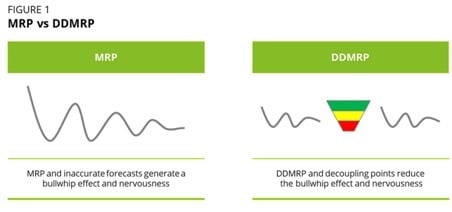
As seen above, inserting and monitoring stock buffers at critical points in the supply chain helps supply chain executives respond in real-time to variation, and decrease lead times.
Traditional MRP vs. DDMRP
|
|
Traditional MRP |
Demand-Driven MRP (DDMRP) |
|
Basis |
Forecasts and predictions |
Actual consumption and demand |
|
Lead time |
Long, cumulative, inflexible |
Flexible, quickly shortened |
|
Inventory |
High, “just in case” |
Strategic, protected flow |
|
Result |
Firefighting, rushing orders |
Stability, reduced chaos |
It’s clear from the table above that DDMRP transforms inventory from a cost into a strategically managed asset.
According to Microsoft, companies using DDMRP software typically achieve 30-45% inventory reductions while improving service levels. This reduces the need to borrow money and shortens the cash conversion cycle.
A stable operation also means resilience to economic shocks, something which is valuable to investors and boards.
Making a demand-driven strategy stick across your supply chain
According to executives polled in a McKinsey study, 60% of IT implementations for supply chain planning either cost more than expected or fail to deliver the expected business outcomes. That’s why education with careful planning and execution are necessary for successful implementation.
A pilot project can show it works but rolling it out company-wide creates real change. Successfully implementing a company-wide DDP system requires focusing on a smart rollout plan and the right technology partner.
In the pharmaceutical industry, demand-driven buffers help balance two critical needs: maintaining service levels for life-saving medicines and avoiding overstocks of products with limited shelf life. This enables resilience and compliance without tying up excessive working capital.
Key changes across the organization:
- Planners shift from reactive firefighters to proactive flow managers
- Sales and operations planning (S&OP) processes align with integrated business planning (IBP) processes to set buffer strategies and review performance. The focus shifts from debating forecasts to improving results.
- KPIs and bonuses are aligned across functions (sales, operations, marketing, finance) around flow-based metrics like service level and cash conversion, not just cost savings
Time-to-value: phased rollout and KPIs the board cares about
When rolling out a new technology, avoid a disruptive "big bang" where you change everything at once. Instead, follow a proven phased approach which is lower risk and shows value faster:
- Pilot: Select a product family with high volatility or stock problems. Define clear targets for service and inventory KPIs.
- Learn & adapt: Use this pilot to train your team and refine your method. Combine what you have learned and assess results.
- Scale: Roll out the model across other product families and regions based on strategic priority.
This approach delivers quick wins that build organizational confidence and demonstrate return on investment (ROI) to the board within a short time.
Build vs. Buy: capabilities, partners, and TCO considerations
While DDMRP principles can be applied manually using spreadsheets, technology is key for scaling.
Take a look at this study by McKinsey of the top 6 IT systems in use for supply chain planning:
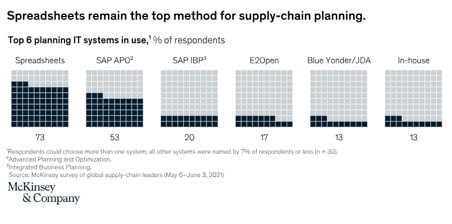
It’s surprising to see how many companies still use spreadsheets (trapping themselves in “Excel hell”) or SAP instead of modern, demand driven tools.
There are two ways to do move towards these systems:
- Build: Enhancing an existing system or building a new one is possible but is complex and requires significant customization and internal expertise.
- Buy: Specialized DDMRP software offers built-in best practices and expert vendor support. It also takes less time to implement.
The decision should be guided by Total Cost of Ownership (TCO) and speed to value. For many executives, working with an experienced vendor that offers a clear roadmap and strong partnership often means lower risk and higher return.
Conclusion
With DDP, the measurable outcomes for the C-suite are clear:
- Stabilized Service Levels: Achieve On-Time-In-Full (OTIF) rates of 95% or higher.
- Higher Inventory Turns: Reduce inventory by 30-45% while improving service.
- Improved Cash Flow: Shorten the cash conversion cycle and free working capital.
- Reduced Risk: Minimize the need for expensive expedited freight and reduce operational chaos.
The question is no longer if you should adopt this model, but how quickly you can start.
Because organizations that continue to rely on traditional forecast-driven approaches will find themselves at a disadvantage compared to competitors who have already embraced demand driven methodologies.
Your Next Steps:
- Identify a pilot: Choose a product family where volatility causes problems.
- Set Targets: Define clear goals for service level (e.g., 95% OTIF) and inventory reduction (e.g., 20%).
- Launch the pilot: Establish a cross-functional team, implement clear weekly reporting, secure executive oversight to monitor progress, and gather feedback from frontline users to refine processes before scaling.