
Discover strategies to boost operational efficiency and turn equipment performance into business growth.
How to measure and improve overall equipment effectiveness
Overall equipment effectiveness (OEE) helps you see where production time is lost and why. This article explains how to calculate OEE, interpret the results, and use them to improve performance and delivery reliability.
Key takeaways
- Overall equipment effectiveness (OEE) = Availability × Performance × Quality. It shows how much of your planned production time produced good parts at ideal speed (ISO 22400-2).
- Use standard terms such as Planned Busy Time (PBT), Actual Production Time (APT), Planned Run Time per Item (PRI), Produced Quantity (PQ), and Good Quantity (GQ) to keep data consistent across sites (OPC Foundation).
- The often-quoted "world-class" OEE of 85% is only a rule of thumb (Plant Engineering, MDCPlus). Set your targets by asset, shift, and product mix.
- Better OEE supports stronger schedule adherence, on-time-in-full (OTIF) deliveries, and improved inventory turns (McKinsey, Deloitte).
You face daily pressure to hit output, quality, and schedule goals. Yet many teams still do not see in real time where production time is lost. Operators chase alarms, supervisors work through spreadsheets, and planners change schedules without knowing if the line will meet the plan. This leads to common issues: unexpected changes, micro-stops that no one records, and scrap that shows up too late to prevent missed deliveries.
Overall equipment effectiveness (OEE) offers a clear way to track how much of your planned time turns into good output. With one number and three drivers, OEE shows if time losses, speed losses, or quality losses are holding you back. In this article, you will learn what OEE means, how to calculate it, how to read the results, and how to act on them. We also link OEE to broader supply chain measures like throughput, yield, and OTIF, so you can connect shop floor results with customer service and delivery performance.
What OEE stands for and why it matters on the shop floor
OEE stands for overall equipment effectiveness. It measures how well-planned production time is used to make good output at the right speed (ISO 22400-2).
The score is based on three parts. Availability shows how much of the planned time is lost to downtime or setups. Performance shows whether equipment runs at its ideal speed. Quality shows the share of output that meets specification the first time. Together, these factors reveal how much of your available capacity is truly effective.
The value of OEE is that it makes problems visible early. If availability drops or small stops increase, the shift can act before orders slip or scrap piles up. This gives managers a clear view of where planned time is wasted and helps teams focus on the losses that matter most.
Defining OEE in practical terms for production teams
When a line supervisor says "we had a good shift," OEE provides the data to back that up or identify hidden losses. It answers three fundamental questions that every shift faces:
- How much time did we run?
- How fast did we run when we were running?
- How much did we get right the first time? This clarity helps teams move beyond gut feelings and unverified evidence. Instead of debating whether a particular changeover (switching to a different product) was "normal" or "too long," teams can compare actual changeover time against planned time and see the impact on availability.
Breaking down OEE into three key factors: availability, performance, quality
The three OEE factors capture different types of losses:
- Availability captures time-based losses from planned downtime (maintenance, changeovers) and unplanned stops (breakdowns, material shortages). Planned losses require better scheduling, while unplanned losses need reliability improvements.
- Performance measures speed losses against ideal cycle time. Equipment may run below optimal speed due to minor adjustments, operator hesitation, or upstream supply chain issues. These losses are often invisible because the line appears normal.
- Quality represents output meeting specifications without rework. This includes obvious defects caught immediately and subtle issues surfacing later. Quality losses are often most expensive because they consume resources while producing nothing of value.
Why OEE matters: early problem detection and smarter use of planned time
OEE provides an early warning system for production problems. A gradual decline in performance might signal wearing components before they cause a complete breakdown. A drop in availability could reveal scheduling conflicts or maintenance issues before they impact customer deliveries. Quality trends can highlight process drift before it results in loss of materials or customer complaints. For managers, OEE data supports better resource allocation. Rather than spreading maintenance attention equally across all assets, teams can focus.
OEE meaning in manufacturing: simple definition and context
In manufacturing, OEE belongs to the broader group of key performance indicators (KPIs) that track operational effectiveness. Various systems and methodologies use OEE as either a data source or improvement target.
Common terms and acronyms you'll hear when talking about OEE
When implementing OEE, teams encounter various related systems and concepts:
- Manufacturing Execution Systems (MES) serve as the primary data source for OEE calculations, capturing machine states, production counts, and quality results.
- Manufacturing Operations Management (MOM) platforms extend MES capabilities to include planning, scheduling, and resource allocation based on OEE insights.
- Total Productive Maintenance (TPM) programs use OEE as a cornerstone metric, focusing on the six big losses that impact equipment effectiveness.
- Lean manufacturing initiatives leverage OEE to identify waste and drive continuous improvement across production processes.
- Six Sigma projects use OEE data to establish baselines and measure improvement results from process optimization efforts.
- Advanced Planning and Scheduling (APS) systems increasingly incorporate real-time OEE data to adjust production plans dynamically.
- Enterprise Resource Planning (ERP) systems consume OEE summaries for capacity planning and performance reporting, creating a connected view from shop floor to enterprise planning.
How OEE relates to other manufacturing KPIs (throughput, yield, OTIF)
OEE connects directly to throughput, which measures the rate of finished goods production. When OEE improves through better availability or performance, throughput typically increases without additional resources. However, the relationship is not always linear, as bottlenecks in other parts of the process may limit overall throughput gains.
First-pass yield measures the percentage of products that meet quality standards without rework, which directly correlates to OEE's quality factor. However, yield may be measured at different points in the process, while OEE quality focuses on the immediate output of a specific asset or line. Understanding this distinction helps avoid double-counting quality issues or missing problems that occur downstream.
On-time-in-full (OTIF) delivery performance depends heavily on production reliability, which OEE helps measure and improve. Higher availability reduces the risk of schedule disruptions, better performance ensures planned production volumes are achieved, and improved quality prevents delays caused by rework or quality holds. McKinsey research shows that manufacturers with consistently high OEE typically achieve 95% or better OTIF performance.
How OEE tracking pinpoints where productivity is lost
OEE analysis reveals loss patterns that may not be obvious from traditional production reports. For example, a line might meet daily volume targets but show poor OEE due to excessive changeover time. This indicates an opportunity to improve setup procedures rather than pushing for higher speeds during production runs.
The three-factor breakdown helps prioritize improvement efforts. If availability is consistently the weakest factor, maintenance and reliability programs should take priority. When performance lags, focus shifts to operator training and process optimization. Quality issues might require statistical process control, supplier development, or design changes.
Trends over time provide additional insights. Gradually declining performance might indicate normal wear that requires scheduled maintenance. Sudden availability drops could reveal operator training needs or procedure compliance issues. Quality patterns that correlate with shift changes, material lots, or environmental conditions guide targeted improvement efforts.
What are the four components of the OEE overall equipment effectiveness framework?
While OEE traditionally focuses on three factors, some organizations add a fourth component: utilization. This creates the expanded TEEP (Total Effective Equipment Performance) measure, which accounts for how much of the total available time equipment is actually scheduled for production.
Utilization, when included, measures planned production time against total calendar time. This factor reveals opportunities to increase equipment usage through better scheduling, reduced planned downtime, or extended operating hours. However, maximizing utilization is not always desirable, as equipment needs maintenance time and operators need breaks. The four-component framework is particularly useful for capital-intensive industries where equipment utilization directly impacts return on investment.
Calculating OEE: formula, factors, and worked examples
The OEE formula is straightforward when you use clear definitions (OPC Foundation):
Availability = APT ÷ PBT
Performance = (PRI × PQ) ÷ APT
Quality = GQ ÷ PQ
OEE = Availability × Performance × Quality
Where APT is Actual Production Time, PBT is Planned Busy Time, PRI is Ideal Cycle Time, PQ is Produced Quantity, and GQ is Good Quantity.
The OEE formula explained simply: availability × performance × quality
Each component of the OEE formula addresses a different type of loss:
- Availability captures time when equipment should be running but is not, including planned stops (changeovers) and unplanned stops (breakdowns). It divides actual production time by planned production time.
- Performance measures speed losses during production time. Even when running, equipment may not achieve ideal cycle time due to minor stoppages or reduced speeds. It multiplies ideal cycle time by quantity produced, then divides by actual production time.
- Quality accounts for output not meeting specifications, including immediate defects and products failing later inspection. It divides good quantity by total produced quantity.
Step-by-step OEE calculation example using real production data
Imagine a packaging line during an 8-hour shift. The shift includes 480 minutes of scheduled time, with 60 minutes planned for breaks, changeover, and cleaning, leaving 420 minutes of planned production time. During the shift, unplanned stops totaled 45 minutes, resulting in 375 minutes of actual production time.
The ideal cycle time for the current product is 0.5 minutes per unit. The line produced 700 units during the 375 minutes of production time. Quality inspection found that 680 units met specifications, while 20 units required rework or disposal.
|
Step |
Time (minutes) |
Description |
|
Planned Busy Time |
420 |
Total time scheduled for production (excluding breaks, cleaning, etc.) |
|
Unplanned Downtime (Availability) |
-45 |
Time lost to breakdowns, material shortages, etc. |
|
Speed Loss Time |
-25 |
Time lost because machines ran slower than ideal cycle time |
|
Quality Loss Time |
-10 |
Time spent making defective or reworked products |
|
Good Time @ Ideal |
340 |
Time used to produce good units at ideal speed |
|
OEE |
340 / 420 = 81% |
Final metric showing that 81% of planned busy time was converted into good production at ideal speed |
Availability = 375 ÷ 420 = 89.3%
Performance = (0.5 × 700) ÷ 375 = 93.3%
Quality = 680 ÷ 700 = 97.1%
OEE = 0.893 × 0.933 × 0.971 = 81.0%
This calculation reveals that availability is the primary constraint. The 45 minutes of unplanned downtime represents the largest opportunity for improvement. Performance is strong, suggesting the line runs well when it operates. Quality is also good, with only a 3% defect rate.
Tools and automations
Excel remains the most common tool for OEE tracking in many facilities. A basic spreadsheet can capture the five key data points needed for calculation: planned production time, actual production time, ideal cycle time, produced quantity, and good quantity. Formulas can automatically calculate availability, performance, quality, and overall OEE.
For organizations ready to automate, Manufacturing Execution Systems (MES) like Sedapta can capture production data automatically. Machine sensors provide real-time information on run status, cycle times, and production counts. Quality systems feed defect data directly into OEE calculations. This automation improves accuracy and provides more timely feedback but requires integration between multiple systems.
Common mistakes to avoid when calculating OEE
Inconsistent time definitions create confusion across teams. Some include planned downtime in availability calculations while others exclude it. Clear, documented definitions are essential for consistent measurement across the organization.
Performance calculations often fail because teams rely on theoretical cycle times rather than realistic current speeds. When small, frequent stops go untracked, the numbers look better than reality, but those tiny delays accumulate into significant losses.
Quality calculations become misleading when reworked parts count as good output. Accurate OEE requires counting only first-pass products that meet specifications. Additionally, comparing OEE across different process types leads to misleading conclusions. Meaningful benchmarking requires comparing similar operations.
Interpreting OEE scores: targets, quality losses, and what 85% means
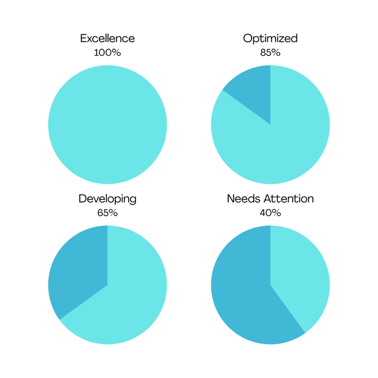
Many industry studies call 85% OEE "world-class" (Plant Engineering, MDCPlus). This is a rough guideline, not a hard rule. The best use of OEE is to compare your own assets, shifts, and product mixes over time and to drive steady improvement.
What does 85% OEE mean?
The 85% benchmark represents a balance between theoretical maximum and practical reality, typically requiring availability above 90%, performance above 95%, and quality above 99%. However, context matters significantly. A dedicated high-volume line should achieve higher OEE than a flexible manufacturing cell with frequent changeovers, and process industries typically see higher OEE than discrete manufacturing with batch production.
The 85% target assumes you have good equipment maintenance, skilled workers, reliable suppliers, and consistent processes. Organizations lacking these fundamentals may need to address infrastructure issues first, while world-class operations may sustainably exceed 90%. Rather than fixating on 85%, focus on understanding your current performance and identifying the most impactful improvement opportunities based on your specific constraints.
OEE Performance levels:
Understanding each factor: is quality, performance, or availability causing you problems?
Availability issues typically stem from equipment reliability, changeover efficiency, or material supply problems. Low availability with high unplanned downtime suggests mechanical problems, operator skill gaps, or inadequate maintenance. Low availability despite good reliability might indicate excessive changeover time or material shortages.
Performance problems often reflect process optimization opportunities or minor technical issues. Gradual performance decline might signal wearing components, process drift, or changing material properties. Sudden performance drops could indicate operator training needs or equipment adjustments.
Quality losses usually point to process control issues, incoming material variation, or design problems. Irregular quality issues might reflect process instability or operator consistency problems. Consistent quality problems often require fundamental process or design changes.
Pattern analysis provides additional insights. Issues that correlate with specific operators suggest training opportunities. Problems that align with particular materials or products might indicate supplier issues or process capability limits. Time-based patterns could reveal environmental factors or equipment warm-up effects.
Setting baselines and targets by asset, shift, and product mix
Establishing meaningful baselines requires at least four weeks of data to account for normal variation in product mix, operator rotation, and maintenance activities. Asset-specific baselines must consider equipment age, complexity, and design capability, Newer equipment typically achieves higher availability. Complex multi-station equipment often shows lower OEE than simple machines due to higher failure probability and longer changeovers.
Shift-based analysis reveals operator training needs and procedural compliance variations, while product mix effects help optimize scheduling by grouping products to minimize changeovers. Setting improvement targets requires balancing ambition with realism.Use challenging but achievable short-term targets with longer-term stretch goals that require systematic improvement efforts.
Avoiding vanity metrics: drive root-cause fixes and sustained reliability
OEE numbers can be misleading if people game the system instead of fixing real problems. Teams might avoid making difficult products, schedule maintenance when it doesn't count, or lower quality standards to make their numbers look better. These tricks don't solve anything.
Real improvement means fixing the actual problems. If machines break down too often, you need better maintenance, not clever scheduling around the breakdowns. If production runs slowly, you need to improve the process, not just make easier products.
Look at what's really causing the losses. Check your maintenance practices, training programs, supplier quality, and process controls.
You need more than just OEE numbers. For machine reliability, track how often equipment fails and how long repairs take. For production consistency, monitor process quality and keep records of operator training. These measurements help ensure your OEE improvements will stick around.
From line performance to supply chain impact: where OEE fits
Improvements in OEE have effects beyond the line itself. When availability and performance are stable, production schedules are more reliable. This improves OTIF, because orders are less likely to be delayed by late scrap or unplanned downtime. It also supports lower buffers, which improves inventory turns (McKinsey, Deloitte).
How OEE helps you meet schedules, deliver on time, and use inventory better
Sticking to the schedule is much easier when production is steady and predictable. Lines that perform well (with high OEE) usually hit their targets on time. This helps everything that follows, like shipping and logistics, run smoothly. But when performance is poor, schedules can shift unexpectedly, causing ripple effects across the supply chain. That often means keeping extra inventory, rushing orders, and having to update customers about delays.
Improving how well equipment runs helps deliveries stay on track. When machines are available and working properly, it's easier to meet production goals and avoid delays. Running at the right speed keeps things moving on time, and making fewer mistakes means less time fixing problems. Enhanced quality prevents delays caused by rework or quality holds that can disrupt shipping schedules.
Reliable production also helps manage inventory better. When output is steady, companies don’t need to keep as much extra stock. They can produce smaller batches more often, which makes it easier to adjust to changes in demand. Well-functioning equipment also supports producing just what is needed and reducing waste.
Better equipment performance saves money in other ways too. It cuts down on rush orders, extra work hours, and fines for late deliveries. It also helps companies get more value from their existing machines and reduce costs from product issues while keeping customers happy.
Scaling OEE tracking across multiple sites or production lines
Multi-site OEE implementation requires standardized definitions and measurement procedures. The ISO 22400-2 standard provides a framework for consistent OEE calculation across different locations and equipment types. However, local adaptation may be necessary to account for site-specific conditions or equipment capabilities.
Technology infrastructure must support multi-site collection and reporting. Cloud-based systems consolidate data from multiple locations while integrating with existing MES and ERP systems. Local systems must remain reliable and user-friendly for consistent data collection.
Change management and governance become crucial when scaling across sites. Training programs must address both technical calculation aspects and cultural change, while clear escalation procedures handle data quality issues. Success stories from early adopter sites help build support for broader rollouts, with regular review meetings enabling best practice sharing.
Conclusion
OEE is a clear and practical measure of how well-planned time produces good output at the right speed. By breaking the score into availability, performance, and quality, managers can see which factor is holding them back and act on it.
When used consistently, OEE stabilises throughput, protects yield, and supports schedule adherence. This leads directly to stronger OTIF, higher asset and labour use, and lower scrap (Deloitte). For supervisors and mid-level managers, it provides both a daily tool for problem detection and a way to link shop floor improvements to supply chain results.
Start with baseline measurements on your most critical assets, identify the biggest loss categories, and implement systematic improvements. With consistent application and proper interpretation, OEE becomes a powerful tool for operational excellence and supply chain performance improvement.