
The Future of Food Supply Chains: Innovation Beyond 2026
From shelf life optimization to AI intelligent forecast: discover how F&B leaders are shifting from reactive crisis management to predictive supply chain excellence.
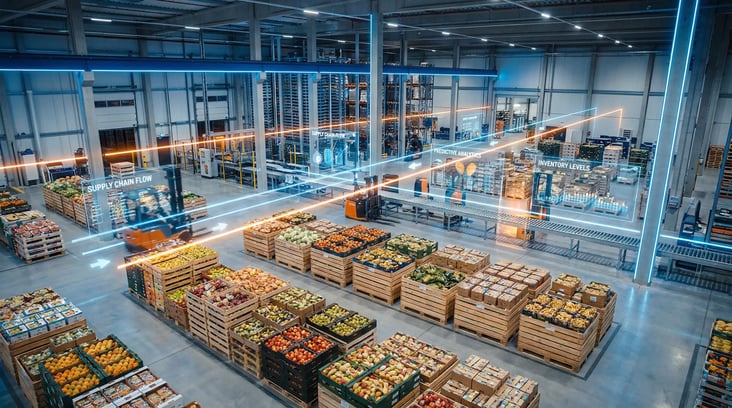
The end of the spreadsheet era
Let's start with an uncomfortable truth: most F&B companies still manage critical decisions through a patchwork of ERP exports, Excel files, and institutional knowledge stored in the heads of senior planners.
A 2024 survey by Food Navigator found that over 45% of food companies cited lack of integrated systems as their primary barrier to adopting predictive technologies. This fragmentation isn't a technology problem. It's an organizational one. Demand planning sits in one department. Production scheduling in another. Quality and traceability in a third. Each group optimizes for their own KPIs, often at the expense of the whole.
The result? A fresh dairy producer might nail their weekly demand forecast but miss the fact that a key ingredient supplier is running three days behind schedule. A snack manufacturer might optimize production runs for efficiency while ignoring the promotional calendar that marketing just changed.
A beverage company might hit their OTIF targets while accumulating safety stock that will exceed its remaining shelf-life threshold before it can be sold, supermarkets won't accept fruit juices with only one month of residual life, even if they're technically not expired.
The companies pulling ahead aren't the ones with the biggest IT budgets. They're the ones that have broken down these silos and built what practitioners increasingly call "end-to-end orchestration", a continuous planning loop where demand signals, production capacity, inventory positions, and supplier status all feed into a single decision-making framework.
From forecast to intelligent forecast: a fundamental shift
Traditional demand forecasting relies on historical patterns. Take last year's sales, apply a growth factor, adjust for known promotions, and hope the market cooperates. For shelf-stable products with predictable consumption patterns, this approach works reasonably well. For fresh products with short shelf lives and volatile demand? It's a recipe for waste.
AI-powered intelligent forecast represents a different paradigm entirely. Rather than extrapolating from the past, these systems continuously incorporate real-time signals: point-of-sale data, weather forecasts, social media sentiment, competitor activity, local events that might affect consumption patterns, and crucially, global disruptions like economic crises, tariffs, conflicts, and sharp energy cost increases that ripple through entire supply chains.
The results are striking. McKinsey research indicates that AI-driven demand forecasting can reduce errors by 20-50% and shrink inventory needs by up to 30%. Church Brothers Farms, a major produce supplier, reported a 40% increase in short-term forecasting accuracy after implementing AI-based planning tools. Danone achieved a 30% reduction in lost sales by ensuring products were available when and where customers needed them. These aren't pilot projects or proof-of-concept experiments. They're production deployments delivering measurable ROI. But there's a catch.
AI systems are only as good as the data feeding them. If your demand planners can't see real-time inventory positions, if your production schedules live in a different system than your sales forecasts, if your supplier lead times exist only in someone's head, the most sophisticated algorithm in the world won't save you.
Shelf life: the constraint that defines everything
In food and beverage, time isn't just money. It's product quality, food safety, and regulatory compliance all wrapped into one relentless countdown. Most ERP systems handle FIFO (First In, First Out) reasonably well. But FEFO (First Expiring, First Out) is a different beast entirely.
It requires knowing not just when product arrived, but when it was produced, what its remaining shelf life is at any given moment, and how that shelf life changes as product moves through different temperature zones in the supply chain. Advanced shelf life optimization goes further.
The real opportunity lies in orchestrating the entire chain, from procurement to production, from warehousing to shipping, to maximize freshness while maintaining the right volumes. Producing a fresh product in the morning and shipping it by early afternoon is fundamentally different from producing it in the afternoon and shipping it the next day.
Advanced planning systems optimize these sequences end-to-end, ensuring that production timing, inventory allocation, and dispatch schedules work together to deliver maximum residual shelf life to customers, not just products that are technically within date.
This matters because the traditional approach, building in safety buffers and hoping for the best, is expensive. Every extra day of safety stock is capital tied up in inventory that could spoil before it sells. Every conservative expiration estimate is a customer who might have bought that product if it had been available. The companies getting this right are integrating temperature sensors, production timestamps, and dynamic shelf life models into their inventory management systems. They're making allocation decisions not just based on what's available, but on what will remain saleable by the time it reaches the end customer.
The sustainability imperative: from checkbox to competitive advantage
For years, sustainability in F&B meant publishing an annual report with some green imagery and vague commitments to "reduce our environmental footprint." That era is ending.
The EU's Corporate Sustainability Reporting Directive (CSRD) is rolling out in phases, with large companies already reporting and mid-sized enterprises following in 2027-2028. Unlike previous frameworks, CSRD requires detailed disclosure of Scope 3 emissions, the carbon footprint of your entire supply chain, from farm to fork.
For food and beverage companies, Scope 3 typically represents 80-90% of total emissions. You can install solar panels on every warehouse and switch your fleet to electric vehicles, and you'll barely move the needle if your agricultural suppliers are using carbon-intensive practices. The companies treating this as a compliance exercise are missing the point.
Sustainability optimization and operational efficiency are converging. Reducing food waste cuts emissions and improves margins.
Optimizing transportation routes lowers fuel costs and carbon footprint. Extending shelf life through better cold chain management reduces the need for urgent restocking and minimizes spoilage. The data infrastructure you need for CSRD reporting, tracking carbon intensity across suppliers, measuring waste at each stage of the supply chain, documenting traceability from origin to consumer, is the same infrastructure that enables better operational decisions.
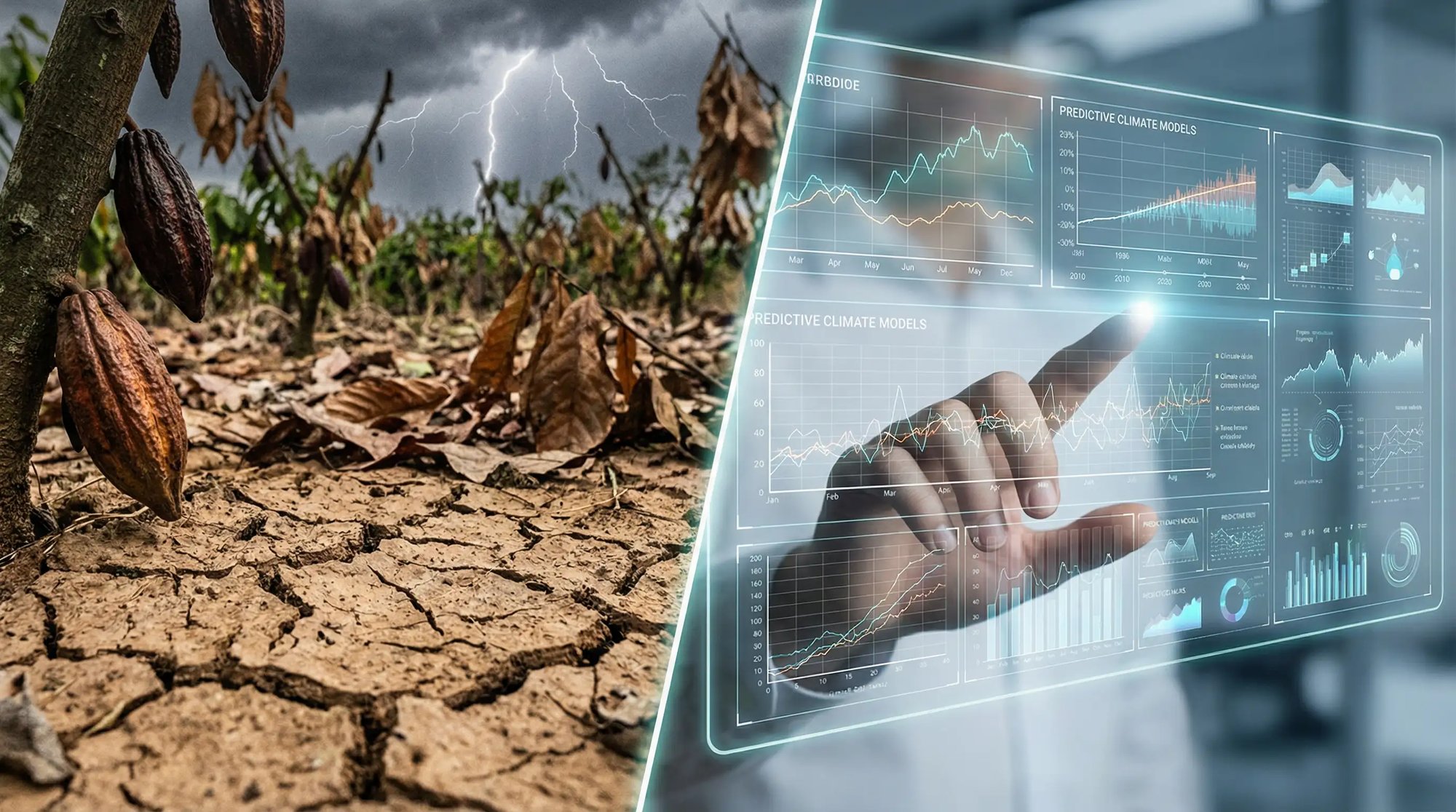
Climate volatility: why scenario planning matters
If you're sourcing cocoa, coffee, or citrus, you already know what climate volatility looks like. Côte d'Ivoire and Ghana, which produce 60% of the world's cocoa, saw production fall 14% in the 2023-24 growing season due to unseasonably dry weather. Orange juice prices spiked as Florida groves faced back-to-back hurricane seasons. European wheat yields fluctuated as the continent experienced both historic droughts and flooding within the same year. These disruptions aren't going away.
The question for supply chain leaders isn't whether volatility will affect their operations, it’s whether their planning systems can model the impact fast enough to respond. This is where scenario planning becomes critical.
What happens to your production schedule if a key ingredient delivery is delayed by two weeks? How does a 20% price spike in packaging materials affect your margins across different product lines? If a major supplier goes offline, which customers get priority allocation? Traditional planning approaches answer these questions through weeks of manual analysis, by which time the situation has often changed again. Modern planning platforms enable planners to run multiple scenarios in minutes, comparing outcomes across different assumptions and constraints.
The goal isn't to predict the unpredictable, but to compress the time between disruption and informed response. The companies building this capability now aren't just preparing for the next crisis. They're building the organizational muscle to navigate continuous uncertainty, turning what used to be emergency firefighting into structured, repeatable decision-making.
Digital twins: simulation before execution
The concept of a "digital twin" has been around for decades in aerospace and automotive manufacturing. A virtual replica of a physical system that can be used to test changes before implementing them in the real world. In food supply chains, digital twins are finally becoming practical.
A digital twin of your production facility can simulate the impact of a new product introduction, a line changeover, or a maintenance shutdown without disrupting actual operations. A digital twin of your distribution network can model the effects of adding a regional warehouse or changing carrier assignments.
The real power emerges when these twins connect. What happens to my production schedule if a key supplier goes offline for two weeks? How does a 15% demand increase in one region affect stock availability in others? What's the carbon impact of shifting from road to rail for a specific lane?
These questions used to require weeks of analysis by specialized teams. With well-implemented digital twins, planners can run scenarios in minutes and make better decisions faster. The technology is still maturing. Most implementations today focus on specific functions rather than end-to-end supply chains. But the trajectory is clear, and companies building the foundational data infrastructure now will be positioned to capture value as the tools evolve.
Traceability: from regulatory requirement to business enabler
The EU General Food Law (Regulation EC 178/2002) already requires F&B companies to trace products one step forward and one step back in the supply chain. But "one step" traceability is increasingly insufficient.
Consumers want to know where their food came from.
Retailers want to verify sustainability claims. Regulators want rapid identification of contaminated products. And supply chain managers want visibility into supplier performance that extends beyond their direct relationships.
Blockchain-based traceability systems are moving from pilot projects to production deployments, particularly for high-value products where provenance matters: specialty coffee, organic produce, sustainably-sourced seafood. These systems create immutable records of product journey, making it possible to trace a specific batch from farm to consumer in seconds rather than days. But blockchain isn't a silver bullet.
The data entering the chain is only as reliable as the people and systems creating it. A fraudulent supplier can enter false information into a blockchain just as easily as into a spreadsheet. The technology enables transparency; it doesn't guarantee it. The practical approach for most F&B companies is layered: robust internal traceability systems that capture production and handling data automatically, integration with supplier systems where possible, and selective use of blockchain or similar technologies for specific products or markets where the value proposition is clearest.
The integration imperative
Everything discussed so far, intelligent forecast, shelf life optimization, sustainability tracking, climate risk management, digital twins, traceability, shares a common requirement: connected data flowing across organizational boundaries.
The traditional approach of best-of-breed point solutions, each optimizing its own domain, has reached its limits. When your demand planning system can't see real-time production status, when your inventory management system doesn't know supplier lead times, when your quality system operates in isolation from your logistics system, you're making suboptimal decisions everywhere. The concept of a supply chain "control tower" has evolved from a monitoring dashboard to an active orchestration layer. Modern control towers don't just display data; they detect exceptions, recommend actions, and in some cases trigger automated responses to routine situations.
A shipment delayed at customs? The control tower identifies affected orders, evaluates alternative sourcing options, notifies affected customers, and recommends expedited shipping for critical items, all before a human planner has finished reading the alert. This level of automation requires more than technology.
It requires clear business rules, defined escalation paths, and organizational trust that the system will make reasonable decisions. Companies that have invested in process standardization and exception handling frameworks are finding the technology adoption much smoother than those trying to automate chaos.
What this means for your organization
The technology landscape for food supply chain management is evolving rapidly. But technology is the easy part. The harder work is organizational: Breaking down silos. Demand planning, production, logistics, and quality need shared objectives and shared data. This usually requires changes to incentive structures and reporting relationships, not just system integration. Building data foundations.
AI and advanced analytics require clean, consistent, timely data. For many organizations, the prerequisite investment in data quality and master data management is more substantial than the analytics tools themselves. Developing talent. Supply chain planning is becoming increasingly technical. The skills that made someone an excellent planner five years ago aren't sufficient for a world of AI-assisted decision-making. Investment in training and selective hiring of data-literate planners is essential. Managing change. Planners who have spent careers developing intuition and relationships may feel threatened by systems that claim to do their job better. Successful implementations position technology as augmentation rather than replacement, freeing planners from routine analysis to focus on complex decisions and exception handling.

Looking ahead
The food supply chains that thrive over the next decade will share certain characteristics: they'll be predictive rather than reactive, integrated rather than fragmented, transparent rather than opaque, and resilient rather than brittle. The path to get there isn't a single technology implementation or organizational restructuring.
It's a sustained journey of capability building, starting with the problems that matter most to your specific business. For some organizations, that starting point is demand forecasting accuracy. For others, it's shelf life management or supplier visibility or sustainability tracking. The common thread is moving from gut feel and spreadsheets to data-driven decision-making, from firefighting to prevention, from hoping the supply chain performs to knowing it will.
The companies that start that journey now will be setting the competitive pace in 2026 and beyond. The rest will be trying to catch up.
Ready to see how integrated planning and execution can transform your food supply chain? Request a demo tailored to F&B operations.
Subscribe to our newsletter
Get our latest updates and news directly into your inbox. No spam.