
From batch scheduling to demand planning: how cosmetics manufacturers can turn the personalization wave into an operational advantage, not a bottleneck.

Listen to this article
When SKU counts double and product lifecycles shrink, the real constraint is not creativity - it is the production system behind it.
The global personalized beauty products market is growing at a CAGR of 41.5%, reaching an estimated $6.43 billion in 2026 and projected to expand to more than $207 billion by 2035, according to Business Research Insights. That growth rate is extraordinary. It is also, for cosmetics manufacturers, a compounding operational pressure that their planning and execution systems were not designed to absorb.
More personalization means more SKUs. More SKUs mean shorter production runs, more frequent changeovers, and recipe variation across batches that share the same equipment. Add the volatility of beauty trends - where a product can go viral in 48 hours and exhaust six weeks of planned inventory - and the traditional production planning model built around stable demand and long runs starts to fail visibly. The bottleneck is not formulation or branding. It is the scheduling, planning, and execution infrastructure behind the factory door.
This article examines the specific operational challenges that personalization creates for cosmetics manufacturers, and what a credible agility strategy looks like at the planning, scheduling, and shop floor levels.
Key Takeaways
- Demand for personalized beauty products is structurally growing, with 71% of consumers expecting tailored experiences, creating sustained pressure on SKU counts and batch sizes.
- A mid-size cosmetics plant today may schedule 30 to 50 different batches per week, each with distinct recipes, in-process controls, and changeover requirements - a volume that overwhelms manual scheduling.
- Demand volatility in beauty, driven by viral trends, promotional peaks, and shortened product lifecycles, makes traditional MRP-based forecasting inadequate as a planning foundation.
- Operational agility in cosmetics manufacturing requires connecting three layers: demand planning, production scheduling, and shop floor execution - with data flowing in real time across all three.
- Modular production lines capable of small-batch flexibility saw 37% higher adoption in 2024, and over 60% of new beauty factories built since 2022 include batch-size flexibility infrastructure.
- The ROI case for agile manufacturing in cosmetics is measurable: reduced rescheduling time, lower inventory carrying costs, and faster response to demand signals.
From mass production to mass customization: the shift that changed everything
For most of the 20th century, cosmetics manufacturing operated on a logic borrowed from consumer packaged goods: produce large volumes of standardized products, reduce unit costs through scale, and manage inventory buffers to smooth demand variation. That model rewarded consistency and penalized complexity.
The shift began gradually in the 2000s with the rise of specialty formats and continued accelerating through the 2010s as direct-to-consumer brands started competing on personalization. By 2025, personalization had become a consumer expectation rather than a premium differentiator. According to McKinsey's State of Beauty 2025 report, the era of undifferentiated consumption has given way to a focus on value, individuality, and specificity. Consumers increasingly expect products matched to their skin type, tone, concern profile, and even DNA markers.
The operational translation of that consumer expectation is straightforward and demanding: more formulations, more packaging variants, shorter minimum order quantities, and faster time-to-market for new launches. South Korean brands, often the benchmark for innovation speed in cosmetics, are already operating with over 200 foundation shades and 366 lip color variants in active production simultaneously.
This is not a trend that reverses. The structural drivers - technology-enabled formulation, AI-powered personalization at retail, social media as a product discovery channel - are durable. Cosmetics manufacturers that anchor their operations to mass-production assumptions are building a competitive liability.
The SKU explosion and its real cost on the shop floor
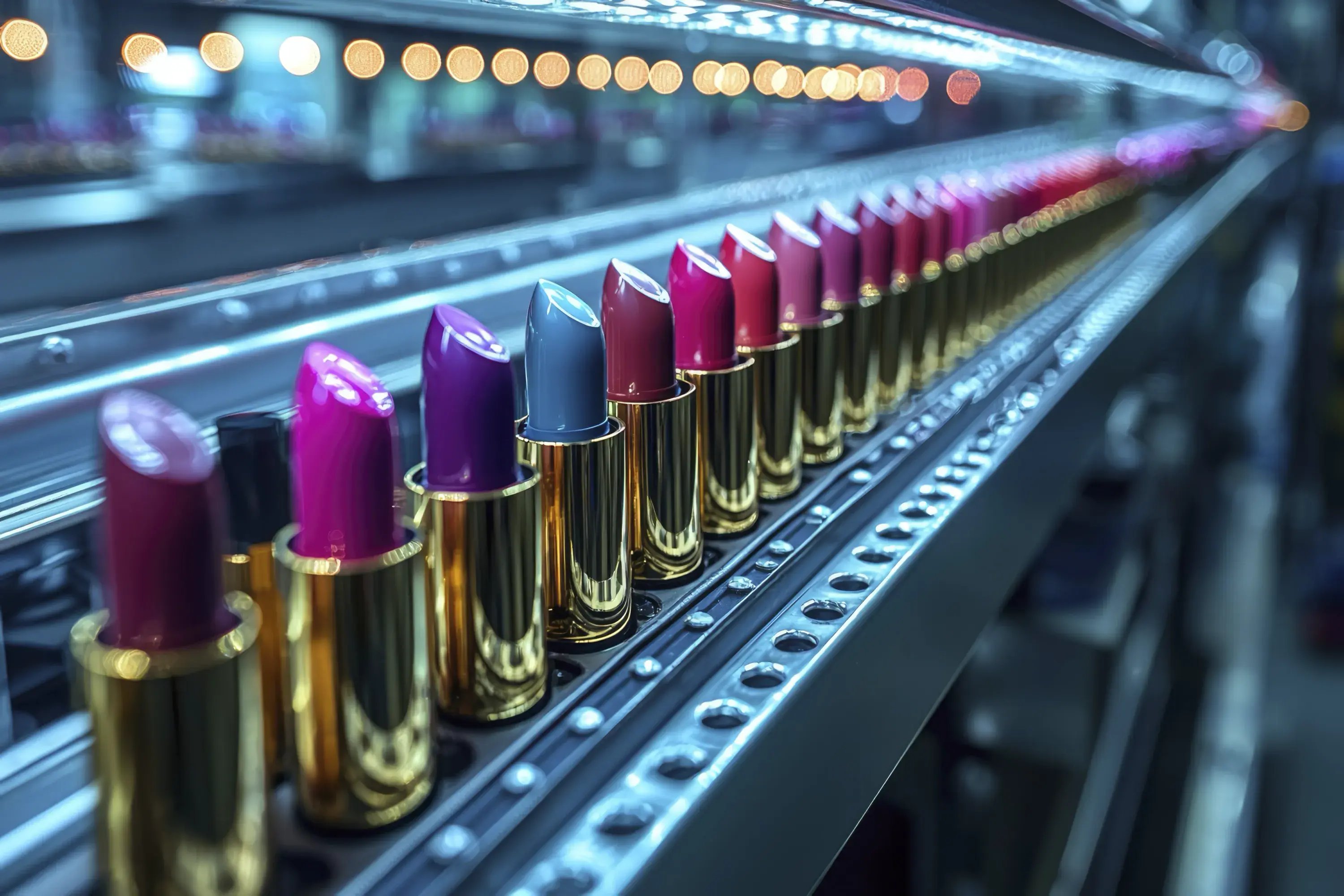
The visible consequence of personalization at the plant level is SKU proliferation. Where a cosmetics manufacturer once managed dozens of active formulations, many now manage hundreds. Each new SKU adds to the scheduling burden in ways that are non-linear: a new formulation requires its own recipe, its own in-process quality checks, and its own changeover sequence from the preceding batch.
A plant manager overseeing a mid-size cosmetics facility might be scheduling 30 to 50 different batches per week, each with distinct cleaning requirements, fill weights, viscosity ranges, and compliance documentation. The sequencing of those batches is not arbitrary: certain formulations must not follow others without a full-flush cleaning cycle, some ingredients have temperature-sensitive processing windows, and filling line capacity is shared across product families with different viscosity profiles.
Managing that sequencing in a spreadsheet was already difficult when the SKU count was stable. When the catalog is growing quarter over quarter and batch sizes are shrinking to accommodate made-to-order and small-batch launches, the manual approach breaks at the first disruption. A batch that fails an in-process quality check triggers a cascade: the failed batch needs rework or disposal, the filling line is held, downstream batches are delayed, and the weekly production plan has to be rebuilt by hand.
The cost of that rescheduling is real. Customized beauty brands face up to 30% higher supply chain management costs compared to mass-production peers, largely driven by the coordination overhead of made-to-order production, according to market data on personalized beauty manufacturing. The labor hours that go into manual rescheduling are invisible on the P&L but visible in missed delivery dates, expedited orders, and overtime.
The hidden cost is not only time. Manual scheduling under pressure introduces errors: a missed allergen conflict between sequential batches, a changeover sequence that leaves residual contamination, a cleaning cycle that runs shorter than required. In a regulated manufacturing environment, those errors carry audit and compliance risk that extends well beyond the production schedule.
Demand volatility in beauty: when the forecast becomes the problem
If SKU proliferation is the structural challenge, demand volatility is the dynamic one. Beauty has always had seasonal demand patterns - suncare peaks in spring, gifting formats in Q4, colour cosmetics aligned with fashion calendar launches. Those patterns were manageable with historical data and safety stock buffers.
What has changed is the speed and unpredictability of demand spikes outside the seasonal calendar. A product featured in a viral social media post can exhaust planned inventory within 48 hours. A dermatologist endorsement on a podcast can create a sustained demand surge that planning cycles had no visibility into a week earlier. These events are not rare outliers - they are structural features of how beauty products reach consumers in 2025.
The implications for demand planning are significant. According to McKinsey's analysis of the 2025 beauty market, 54% of cosmetics industry executives identified uncertain consumer appetite as the greatest risk to business performance. The research also notes that beauty growth is projected at 5% annually through 2030 - a healthy rate, but one accompanied by increasing unpredictability in where and when that growth materializes.
Traditional demand planning approaches - statistical forecasting based on historical sell-through, adjusted for seasonality - struggle with this environment. They are calibrated for stability and penalize novelty. A new product has no history. A viral trend does not appear in a three-year rolling average. A promotional campaign launched in partnership with a digital creator generates a demand spike that looks like noise to a statistical model.
The result is a systematic mismatch between the plan and reality. Planners adjust the plan manually after the fact, which means production decisions were already made on a flawed signal. Inventory builds on slow-moving variants while fast-moving ones run short. Replenishment cycles are too slow to respond to viral spikes, and the production schedule is rebuilt reactively after the disruption rather than proactively before it.
This is the core agility deficit in cosmetics manufacturing: the gap between when the market moves and when the production system responds.
What operational agility actually looks like in a cosmetics plant
Agility in manufacturing is often described in abstract terms - responsiveness, flexibility, adaptability. For a cosmetics plant manager, it has a more concrete meaning: the ability to change the production plan on Monday morning without losing Tuesday's output, and to receive a demand signal on Wednesday that updates Thursday's schedule without requiring a full-day replanning exercise.
That kind of practical agility depends on three connected layers working together.
The demand layer provides the signal. A capable demand management system integrates multiple inputs - sell-through data from retail partners, e-commerce trends, promotional calendars, and near-real-time sales signals - and translates them into production requirements. It does not replace the planner's judgment, but it gives the planner a signal that is current and multidimensional rather than lagged and historical.
The scheduling layer translates demand requirements into executable production sequences. A purpose-built Factory Scheduling system handles the constraints that manual schedulers manage in their heads: changeover compatibility between formulations, cleaning cycle requirements, equipment capacity by product family, and batch sequencing logic that respects both production efficiency and compliance rules. When a disruption occurs - a batch failure, a supplier delay, an equipment breakdown - the system recalculates the impact on the sequence and proposes recovery options, turning a hours-long manual replanning exercise into a guided decision.
The execution layer closes the loop. A Manufacturing Execution System connected to the scheduling system ensures that what happens on the shop floor is captured in real time: batch start and end times, in-process quality results, actual vs. planned yield, and cleaning cycle completion. That data feeds back into the scheduling system, so the plan always reflects actual production state rather than an assumed state that drifted hours ago.
The critical point is connectivity. Each layer exists in isolation in most cosmetics plants today: demand data in one system, scheduling in spreadsheets, execution on paper or in a disconnected MES. Operational agility is not achieved by improving any one layer in isolation. It emerges from the data flow between them.
Modular production lines capable of small-batch flexibility saw a 37% rise in adoption in 2024, according to industry data, and more than 60% of new beauty factories built since 2022 include infrastructure for batch-size flexibility. The physical infrastructure for agility is increasingly available. The planning and execution software to use it effectively remains the constraint for most manufacturers.
The technology enabling agile cosmetics manufacturing
The technology architecture for agile cosmetics manufacturing is not complex in concept, but it requires deliberate integration choices. Three functional layers are necessary; the connectors between them are the critical success factor.
Demand management in cosmetics must go beyond historical extrapolation. It needs to integrate channel-level sell-through data, incorporate promotional uplift modeling, and provide planners with scenario views that show the production and inventory implications of different demand assumptions. For a beauty brand managing 500 active SKUs across three retail channels and its own e-commerce, the planning system must help prioritize which signals to act on and which to absorb through available inventory buffers.
Production scheduling in a process manufacturing environment like cosmetics has requirements that generic scheduling tools do not handle well. Sequence-dependent changeover times (formulation A to formulation B requires a different cleaning protocol than formulation B to formulation A), allergen separation rules, temperature constraints during mixing, and filling line allocation across product viscosity classes all need to be represented as scheduling constraints, not managed as post-scheduling manual checks. When disruptions occur, the scheduler needs to reoptimize against all constraints simultaneously, not just adjust one batch at a time.
MES in cosmetics serves a dual function: execution guidance and compliance documentation. For a plant manager managing GMP-regulated production, every batch needs a complete electronic batch record capturing ingredients used, process parameters, in-process quality results, and operator sign-offs. An MES that generates this documentation automatically from the executed production sequence eliminates the manual transcription burden that is a significant source of documentation errors - and of audit findings.
The integration between these layers is what converts three capable systems into an agile operation. When the demand management system revises the production requirement for a fast-moving SKU, the Factory Scheduling system should receive that update and recalculate the optimized sequence automatically. When the MES reports that a batch took 20% longer than planned, the scheduling system should adjust downstream start times without waiting for a human to reconcile the data.
As the Cosmetics 4.0 article on elisaindustriq.com notes, the foundational challenge in beauty supply chains is the fragmentation of data across systems. The agility layer described here is the operational complement to the traceability and digitalization infrastructure that Cosmetics 4.0 frameworks address.
A practical roadmap for cosmetics manufacturers
Building operational agility in a cosmetics plant is a phased initiative, not a single deployment. The following sequence reflects the dependencies that matter in practice.
1. Map the actual scheduling complexity. Before selecting any technology, document the current state: how many active SKUs, how many batches per week, how many changeover types, and where the manual workarounds are concentrated. The output is a constraint map that defines the scheduling requirements any system must handle.
2. Audit the demand signal. Identify every data source that currently informs the production plan - sell-through reports, sales team inputs, customer forecasts, promotional calendars - and assess the lag between when each source updates and when it reaches the planning cycle. A 10-day lag in sell-through data in a market where viral demand spikes resolve in 48 hours is a structural planning failure.
3. Define the disruption protocol. Establish what "agility" means operationally: how quickly should the production plan respond to a demand spike? What is the acceptable latency between a batch failure and a revised schedule? These parameters define the performance requirements for the scheduling system.
4. Start with scheduling connectivity. The highest-impact first step for most cosmetics plants is connecting the demand signal to the production schedule - reducing the lag between a demand update and a revised production sequence. This does not require a full MES deployment to deliver measurable value.
5. Layer in shop floor execution. Once the scheduling system reflects real constraints and updates in near real time, the next step is closing the loop with execution data. An MES that feeds actual batch completion data back into the scheduler eliminates the largest source of schedule drift: the gap between planned and actual production pace.
6. Build the measurement framework. Track schedule stability (the percentage of production orders executed as planned), replanning frequency (how often the weekly plan is revised), and response latency (time from demand signal to production plan update). These metrics make the agility investment visible and provide the basis for continuous improvement.
7. Expand scenario planning capability. Once the baseline agility infrastructure is in place, add scenario modeling: the ability to run "what if this SKU demand doubles" or "what if this supplier is delayed three weeks" simulations against the actual production and inventory position. This is where agility shifts from reactive to proactive.
Conclusion
The personalization wave in cosmetics is not reversing. Consumer expectations for tailored products are structural, and the market data confirms that brands delivering on those expectations are capturing disproportionate growth. The operational challenge is real and compounding: more SKUs, shorter runs, greater changeover frequency, and demand signals that move faster than traditional planning cycles can absorb.
The answer is not more planners or faster spreadsheets. It is a connected architecture that links demand sensing to production scheduling to shop floor execution, with data flowing in near real time across all three layers. Cosmetics manufacturers that build this infrastructure are not just managing today's complexity - they are creating the operational foundation to scale personalization further without scaling operational cost proportionally.
The companies that will lead in personalized beauty five years from now are likely already making these infrastructure choices today.
Next read: Cosmetics 4.0: How Digitalization is Shaping Beauty Supply Chains - the foundational article on how digital tools are transforming traceability and supply chain visibility in the beauty industry.