
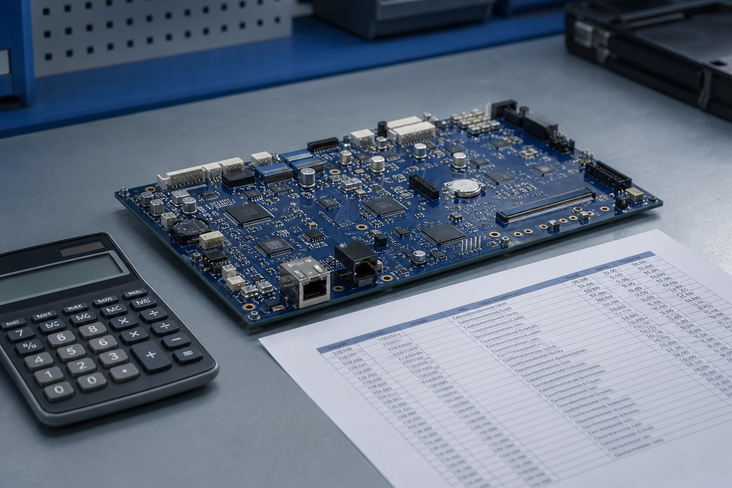
The cost to manufacture an electronic assembly is the cost of the materials and production resources needed to deliver an accepted unit, plus any separately identified development or tooling expense. There is no useful universal dollar figure: the BOM, build quantity, routing, test coverage and yield determine the answer. For an EMS buyer, comparing those assumptions is more valuable than comparing two unexplained unit prices.
This guide focuses on purchased components assembled into boards or finished electronics, not the economics of fabricating semiconductor wafers or individual passive components. Start with a recurring cost per accepted unit, show nonrecurring engineering (NRE) separately, and then calculate the selling price using an explicit margin policy.
Build the Cost Stack Around the Same Deliverable
Define the BOM revision, accepted quantity, manufacturing site, currency and delivery boundary before adding costs. A factory-gate estimate and a delivered estimate are not interchangeable. Neither are a tested PCBA and a complete product with enclosure, programming, serialization and packaging.
| Cost Element | Cost Basis | Comparison Question |
|---|---|---|
| Materials and Bare PCB | BOM consumption and board fabrication | Are the same part numbers, approved alternates and PCB specifications included? |
| Assembly and Test | Labor hours, machine usage and batch setup | Does the routing include handwork, inspection, programming and required test coverage? |
| Factory Overhead | Defined cost pool and allocation driver | Are supervision, equipment and utilities already included in the process rates? |
| Yield and Rework | Terminal scrap plus incremental repair activity | Are rejected starts and recoverable failures treated separately? |
| Packaging and Delivery | Accepted-unit or shipment-level cost | Which freight, duties and packaging obligations are inside the estimate? |
| NRE | Project-specific one-time cost | Are fixtures, tooling and engineering charged separately or amortized? |
Do not add the same support cost twice. A fully burdened process rate may already include machine depreciation or factory overhead; adding a second blanket overhead percentage would inflate the estimate. Conversely, an operator wage rate alone does not pay for the production infrastructure.
Price Materials at the Quantity You Must Buy
Material cost begins with the exact manufacturer part numbers and consumption quantities, not a convenient distributor price for a different tier. Record quote validity, pack size, minimum order quantity (MOQ), currency and the approved alternate used. Include inbound freight and duties once, either within landed material cost or as separate lines.
Excess purchasing is a commercial decision as well as a costing decision. If an MOQ creates usable residual inventory, it is not automatically all consumed by the first job. Decide who owns the balance, whether it is likely to be reused, and whether the customer pays a separate excess-material charge. Obsolete or customer-specific excess may need a different treatment.
PCB fabrication belongs in the same discipline: match layer count, laminate, finish, panelization, fabrication tolerances and lead time to the drawing. A cheaper board quote that excludes the required specification is not a lower-cost equivalent. The same applies to substituting a lower test scope for the required acceptance criteria.
Separate Batch Setup From Production Time
Batch labor cost equals setup labor hours multiplied by the setup rate, plus total run labor hours multiplied by the run rate. If run time is expressed per unit, multiply it by the units processed before applying the rate. Convert minutes to hours when using hourly rates.
Setup repeats with production batches or changeovers; it is not necessarily NRE. Programming and validating a new fixture may be nonrecurring, while loading the fixture and preparing a line for each order is recurring batch work. Separating the two prevents both overcharging repeat orders and underpricing small lots.
Test cost is not just a station cycle time. Include attended operator time, equipment occupancy where relevant, fixture requirements and incremental retest. Automated inspection, electrical test and functional test answer different questions; a lower inspection price is not evidence that it meets the same coverage.
Model Yield Once, Then Add Incremental Rework
A transparent simplified formula is: recurring cost per good unit = (pre-scrap cost per started unit + expected incremental rework cost per started unit) / terminal yield + post-acceptance cost per good unit. Terminal yield is accepted output divided by starts after repair decisions. First-pass yield is different: repaired units can fail initially and still become accepted output.
This formula assumes the pre-scrap costs are incurred on every start. When rejects leave at different stages, a stage-based model is more accurate because early scrap does not consume downstream assembly and test resources. Do not apply a yield divisor to costs already expressed per accepted unit, or add another scrap percentage for the same rejects.
Hypothetical example: the PCB costs $2.50 per start, components $10.00, assembly $3.20, test $1.60 and allocated overhead $2.20. Those pre-scrap costs total $19.50 per start. Packaging and outbound freight total $1.00 per accepted unit. Assume terminal yield of 96%, no additional rework cost, and no recoverable scrap value.
| Calculation | Basis | Result |
|---|---|---|
| Pre-Scrap Cost | $2.50 + $10.00 + $3.20 + $1.60 + $2.20 | $19.50 per start |
| Recurring Cost at 96% Yield | $19.50 / 0.96 + $1.00 | $21.31 per good unit |
| Recurring Cost at 92% Yield | $19.50 / 0.92 + $1.00 | $22.20 per good unit |
| NRE Amortization | $1,500 / 1,000 accepted units | $1.50 per good unit |
| First-Order Cost With NRE at 96% | $21.3125 + $1.50 | $22.81 per good unit |
Calculations use unrounded intermediate values and round the displayed unit cost to cents. Lower terminal yield raises recurring cost by about $0.88 per accepted unit in this example. That change comes from the yield divisor, not a second scrap surcharge. If rework is expected, add its incremental labor and replacement material before division, without recounting the original BOM or normal test pass.
Keep NRE, Cost and Price Distinct
A separate $1,500 NRE charge is easier to track than hiding it in unit cost. If the buyer requests amortization across 1,000 accepted units, show the $1.50 allocation and the volume commitment. An anticipated future order is not the same as committed recovery; specify what happens if the program ends early.
Manufacturing cost is not the selling price. Gross margin uses selling price as its denominator; markup uses cost. For a 20% gross margin, price equals cost divided by 0.80. For a 20% markup, price equals cost multiplied by 1.20. On the unrounded recurring cost of $21.3125, those prices are $26.64 and $25.58 respectively. The 20% markup produces a 16.67% gross margin, not 20%.
Decide whether the pricing policy applies to recurring production alone or to the whole first order including NRE. Also identify costs outside factory production, such as sales support, financing and warranty exposure. A production cost estimate can be sound while still being an incomplete basis for the commercial price.
Make Competing EMS Quotes Comparable
Ask each supplier to identify the quantity tier, revision, test scope, yield basis, setup frequency, NRE recovery and delivery boundary. Then compare the same accepted output. A low unit price with separate recurring setup and customer-owned excess inventory may cost more over the order than a higher all-inclusive price.
Use the broader product-costing perspective to distinguish design choices from purchasing assumptions: reducing handwork or fixture complexity changes the recurring production model, while choosing a different supplier tier changes the material model. Keep those changes visible rather than attributing every difference to negotiation.
Connect the Assumptions to the RFQ
CalcuQuote’s quoting workflow brings BOM cleanup, supplier inputs, material and labor costing, risk checks, approvals and quote history into the RFQ process. That creates a practical place to review which revision, sourcing input and labor assumption drove a cost change, rather than reconciling unrelated totals after the customer has accepted a price.
For labor, configurable activities and drivers support repeatable estimates, and Excel inputs can carry an existing model into the costing workflow. Standard labor costing supports simple rules and activity-based costing; Advanced Labor supports more detailed customer-specific models. Operation-level routing, capacity modeling and closed-loop refinement are an expansion path, not a promise that every standard installation already performs those functions.
Frequently Asked Questions
Does Low Volume Always Mean Higher Unit Cost?
Batch setup and NRE spread over fewer accepted units can raise the cost, and purchasing may fall into a less favorable quantity tier. But compare the actual routing, material commitments and batch frequency; a different production method can change the result.
Should Scrap Be Added as a Percentage?
Only if it is a clearly defined incremental cost allowance. A scrap rate is not automatically the same as a cost surcharge. If the estimate already divides pre-scrap cost by terminal yield, another allowance for those same rejects double-counts the loss.
Is Setup the Same as NRE?
No. Recurring line preparation belongs to the production batch. One-time engineering, tooling and fixture development can be NRE. Keep each item’s recurrence and recovery basis explicit.
Price the Next Build on a Defensible Basis
Take one live RFQ and reconcile the BOM, batch routing, accepted quantity, yield and delivery boundary before negotiating a price. Separate NRE and select the margin calculation deliberately. If your team needs a more consistent way to carry those assumptions into electronics quotes, explore CalcuQuote with a representative BOM and labor model.