
Food & beverage supply chain software selection guide: map your processes, evaluate vendors, and build a solid business case.

Listen to this article
Selecting the right supply chain software for food and beverage (F&B) manufacturing is often complex. It begins with long feature checklists often put together internally or by consultants. And while these are well-intentioned, the lists don’t capture the reality of how food production actually works.
A feature might be marked "yes" on your checklist, but you’re still left with questions.
This guide will help you plan a software selection process and prepare a Request for Proposal (RFP) around business objectives and core processes. Doing this will lead you to vendors who can solve your manufacturing challenges, not just the ones with the longest feature catalogue.
How does the software handle a sudden 200% demand spike from a supermarket promotion? Can it resequence a production line in minutes when a raw material delivery is delayed? Does it seamlessly connect your long-term cocoa bean purchases with your weekly chocolate bar production schedule?
Companies often discover after implementation that their chosen software doesn’t support their actual workflows. This happens because feature lists without context don’t tell you anything about whether a vendor can handle the unique demands of F&B manufacturing.
By the end of this guide, you will know how to:
- Frame pain points and objectives in measurable terms
- Describe your current processes and the transformation journey your company is undertaking, so vendors can demonstrate how their tools support both your operations today and your goals for tomorrow
- Identify industry-specific capabilities that matter the most
- Evaluate integration approaches and total cost of ownership (TCO)
- Build a credible business case to secure executive support
Why food & beverage supply chain planning is different
Traditional supply chain software, typically designed for automotive or electronics, can’t handle the unique dynamics of F&B manufacturing.
Understanding the challenges specific to this industry is important for selecting supply chain solutions that work in practice. In the following sections, we’ll look at the factors that make F&B planning unique and complex: short shelf life, continuous production flows, volatile demand, dual time horizons, minimal error tolerance, and raw material variability. Together, these shape the technical and operational requirements that your software must meet.
Short shelf life
Even within the same facility, there’s shelf-life variability. Fresh or filled pasta, or fresh dairy has a warehouse window of 1-2 days compared to canned goods which can sit for months. This requires sophisticated inventory management that balances freshness requirements of multiple items with operational efficiency throughout the facility.
Continuous production
Discrete manufacturers (for example, automotive) can stockpile parts for months and break down production into stages, but food manufacturers can’t. You can’t warehouse milk or semi-mixed cake batter for months waiting on schedule.
Once a batch starts, it must run from start to finish without interruption. Some processes such as beer brewing follow biological processes that can’t be paused, while others such as chocolate production require precise temperature control through multiple stages without interruption.
This reduces flexibility and makes sequencing optimization, arranging production runs in the most efficient order, even more important. Digitizing the supply chain can deliver significant gains, but only if the software truly aligns with these fast-moving processes.
Demand volatility
High demand fluctuation is a major supply chain challenge today. That's why interest in demand planning tools has increased in recent years.
This is especially important for the F&B industry, where supermarket promotions can double or triple demand volumes overnight and often account for a significant share of yearly sales. Such campaigns require tight coordination across production, logistics, and retail partners, while demand for fresh products can also spike unexpectedly due to weather or local events.
This means that advanced forecasting powered by AI or ML (machine learning) is no longer just a good-to-have feature, but a core function that must be able to replan production weekly, or even daily.
Dual time horizons
F&B companies juggle wide planning horizons: they must manage both long-term sourcing decisions and short-term production schedules that operate on very different timelines.
Balancing these two planning horizons is one of the core challenges in F&B manufacturing. Strategic sourcing must secure raw materials months or even years ahead, while production teams need flexibility to adjust recipes, batch sizes, and schedules daily to protect freshness and meet customer demand. When these two planning levels are disconnected, companies face either raw material shortages or product waste.
- Long-term: Raw ingredients like coffee, cocoa, grains, and some spices may be contracted a year or more in advance based on seasonal harvests. Such long planning horizons ensure that contracts and imports align with expected demand.
- Short-term: Ingredients such as dairy, fruits, and bakery inputs have short production cycles, measured in weeks or days. It is important to maintain freshness and produce finished goods before expiry. Similar short-term constraints also apply to livestock and fish farming, where biological cycles and shelf life leave little room for planning errors. This short planning horizon needs to react to immediate changes in supply or demand.
Limited error tolerance
In discrete industries, a wrong forecast may show up as excess stock months later. But in an industry such as F&B with tight margins and perishable goods, an error today means wasted batches tomorrow.
This means that you can’t wait months to correct forecasting errors. Instead, you need systems that are capable of daily or weekly replanning cycles to minimize waste and stockouts.
Raw material availability
Food supply chains can be short because of higher perishability. The quality and availability of agricultural inputs can vary due to weather, seasonality, and biological factors, creating planning complexity that is very different from that in discrete settings with standardized components.
Start with pain points and objectives
Before approaching any vendor, you need to be clear on what problems you want to solve and what your project’s scope is. This will protect you from scope creep and keep vendors focused on your actual needs instead of overselling capabilities you don’t need.
Common pain points in F&B manufacturing
Waste from poor shelf-life management
Inventory expiring or spoiling in stock is one of the largest costs in food manufacturing. In 2022, the European Environment Agency (EEA) found that the EU wasted over 59 million tonnes of food, approximately 132 kg per person:
Food waste 2020-2022 in % and per kg capita
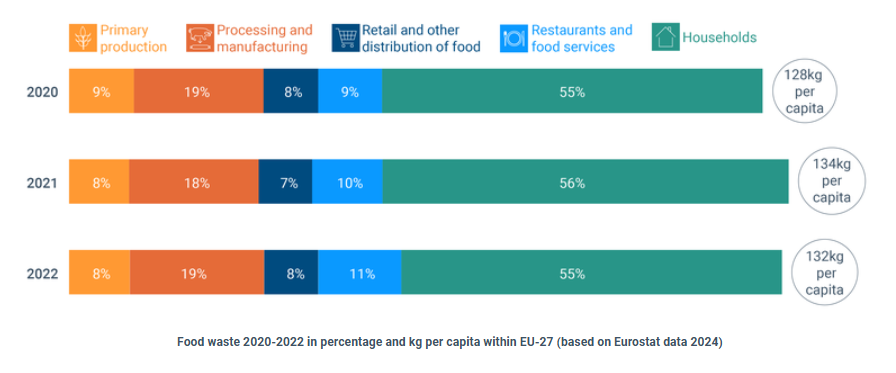
Source: EAA: Food waste 2020-2022 in percentage and kg per capita within EU-27
Demand spikes and volatility
Without advanced forecasting software, you’ll be unable to respond quickly to demand spikes. This can result in missed revenue or excess stock that spoils.
In the F&B industry, these spikes often come from supermarket promotions, seasonal peaks, holidays, or sudden weather changes that shift consumer demand. Effective planning requires tools that can adjust quickly instead of relying on fixed monthly forecasts.
Forecasting errors in short cycles
Food manufacturers can’t absorb forecasting errors the way discrete manufacturers can. In short F&B production cycles, even small forecast errors can snowball into production inefficiencies and emergency rush orders.According to Microsoft (2023), companies using advanced material requirements planning (MRP) software typically achieve 30-45% inventory reductions while improving service levels.
Quality control and compliance
Quality control and compliance are legally mandated in most F&B operations. Integrating HACCP (Hazard Analysis and Critical Control Point) checks and batch traceability should no longer be an afterthought but built into your documentation and workflows.
Production sequencing inefficiencies
F&B manufacturers face production sequencing inefficiencies from excessive changeovers, such as changing recipes, flavor consistency requirements or allergen separation. Mandatory cleaning cycles also reduce throughput.However, according to a McKinsey study, using a well-integrated, AI-powered manufacturing execution software (MES) specifically designed for F&B can lead to a 30-50% increase in productivity while a 20-40% decrease in time-to-market.
Limited visibility
Disconnected data across systems makes it hard to see the real-time status. This lack of traceability also makes it difficult to manage recalls and ensure compliance.
The implementation of the EU’s General Food Law (Regulation EC No 178/2002) and the U.S. Food Safety Modernization Act (FSMA) 204 requirements makes end-to-end traceability a business necessity.
According to Market Growth Reports (2025), digital traceability systems can improve food safety audit compliance by 33% while reducing recall response times by 41%.
Objectives and project scope in F&B manufacturing
Once you’ve identified your pain points, it’s time to define business objectives and project scope. Completing this internal groundwork ensures your RFP is built on a foundation of clear business needs.
Objectives
Some common business objectives in F&B manufacturing:
- Waste reduction targets: Quantify waste reduction targets with specific percentages and timeframes. For example, reducing expired stock by 15% in Q4.
- Service level improvement: Your service level goals must align with retailer requirements. On-Time, In-Full (OTIF) delivery rates above 99% are increasingly common.
- Shorter planning cycles: This impacts responsiveness to market changes and can help you capture promotional demand.
- Tighter integration: Your software must integrate well with existing ERP and MES systems to improve efficiency.
Scope
Defining the scope will help you choose a vendor that provides you the needed capabilities. Ask yourself:
- Is this a greenfield implementation or are we replacing existing planning tools? Greenfield implementations optimize processes from the start while replacements involve change management and data migration for existing users.
- Is this a single-department initiative or a company-wide transformation? Company-wide deployments use unified platforms while department-wise solutions often prioritize deep functionality in narrow areas.
- Which specific processes are in scope? Do you need material requirements planning (MRP), production scheduling, manufacturing execution system (MES), quality control, or a combination of all these? Defining processes specifies which functions you need and how they can be integrated.
Document your processes, not just your features
In your RFP, instead of sending vendors a list of 100 features, give them diagrams of your key processes and ask them to demonstrate how their software can support you.
Shift the conversation from "Can you do this?" to "How can you do this in the context of our operations?"
This will reveal how vendors actually work within your operational context, unlike feature lists that offer no insight into practical implementation.
Why feature lists fail
Features assigned to the wrong stage create confusion during vendor comparisons. For example, capacity planning might appear under scheduling in one vendor's response and under long-term planning in another's.
Similarly, vendor terminology often differs from industry standards. What one vendor calls "demand sensing" might be basic statistical forecasting, while another's "demand sensing" incorporates machine learning models that respond to market signals in real time. A “yes” answer to features in such situations creates confusion, not clarity.
Many vendors also say yes to customizations for particular features, but such responses tell you nothing about how complex the implementation would be or what exactly it would cost.
What if a vendor says that they can support shelf-life management through customization but doesn’t mention that it would take six months to develop? Such timelines are not practical and there’s no way to figure that out with feature lists.
Feature lists also don’t show whether a vendor understands the difference between long-term raw material planning and daily production scheduling in food manufacturing.
What to document instead
Instead of long feature lists that only show which boxes a vendor can tick, you should map out your existing (and target) process workflows. Give vendors a process diagram, not a laundry list of features, to reveal how well their software truly fits your specific needs.
Include the following in your documentation:
- Key processes you want to cover: Show end-to-end processes (for example, sales review, demand planning, material planning, scheduling, production execution, shipping, quality control) and include who performs each step.
- The time horizons for each process: Indicate planning frequency required at each stage. For example, 18-month strategic planning, monthly MRP runs, weekly scheduling, and daily shop-floor orders.
- Integration points between systems: Highlight how data flows between systems (ERP, MES, quality control, warehouse) and departments (sales, planning, procurement, production).
- Hand-off points between different departments: Mark approval points throughout the workflow. For example, finalizing a production plan before release, or quality approvals between shipments.
- Pain points within each process stage: Note where things break down today and where there are bottlenecks. This can be anything from manual spreadsheets to frequent schedule overrides.
Example: A dairy plant's process map
- Long-term planning: Annual planning that secures raw materials such as milk, sugar, and flavour contracts over an 18+ month horizon.
- Material requirements planning (MRP): Monthly planning supports strategic ingredient and capacity alignment, while daily MRP runs generate proposed production and purchase orders for fresh ingredients to meet short-term demand.
- Demand planning: Weekly forecasts incorporating promotions or seasonal peaks to manage demand while optimizing production.
- Production scheduling: Daily shop-floor schedules that sequence products to minimize changeovers and enforce FEFO (First Expired, First Out).
- Execution with an MES: Dispatching orders to production lines and recording actual yields/output.
- Quality and traceability: In-process checks and linking finished products back to specific ingredient batches for compliance.
The sedApta Suite addresses these requirements because all processes operate within a single system architecture. However, many vendors specialize in only one time horizon, meaning their software focuses either on long-term planning (like procurement and capacity) or short-term scheduling (like daily production and sequencing), but not both. This gap doesn't show up on feature lists. You need to map your processes to find it.
To create these process maps, involve a cross-functional team and use simple flowcharts or swim-lane diagrams. And don’t forget exception flows to show how rush orders or substitutions are handled.
This documentation approach reveals critical integration points that feature lists miss. For example, when a quality control failure occurs during production, the system must automatically adjust downstream scheduling, update inventory availability, and trigger supplier notifications if raw material issues are identified.
In your RFP, ask vendors: "Here is our process workflow. Explain how your solution handles each stage and how the stages connect. Please specify which parts are native capabilities versus customisation versus separate products."
This reveals whether vendors truly understand F&B manufacturing or are simply adapting generic solutions. It forces them to describe real capabilities, not just buzzwords.
This approach naturally advantages platforms that offer unified coverage, helping you avoid the cost and complexity of "system sprawl" from multiple disconnected point solutions.

Industry-specific features that matter
Once you map out processes, you can identify the capabilities that really matter. Each feature must tie back to a priority. For example, if changeovers are a top pain, put production sequencing on your RFP checklist; if recalls are a risk, make traceability non-negotiable.
Key software capabilities
Shelf-life management
Shelf-life management requires sophisticated algorithms that track expiration dates and implement FEFO logic throughout the supply chain to reduce waste. They may integrate quality control data (such as microbial test results).
It is also important to manage freshness constraints, not only shelf life. Freshness means the remaining shelf life required by the end customer, for example a supermarket. It determines whether the product will be accepted and the order considered fulfilled. Good systems need to handle both shelf life and freshness requirements to ensure timely delivery and compliance with customer standards.
Traceability and recall readiness
Given strict food safety regulations (FDA, EU Food Law), your system should track batches through every stage of production. So that if a recall is needed, you’re able to generate the path forward and backward from any given batch.
By-products and co-products handling
In many F&B processes, one production process creates multiple products or by-product (e.g. cheese production creates whey). Your planning software should handle products with separate planning and costing models. The planning model schedules and allocates resources for each output. The costing model calculates the financial value of each product or by-product. Both should integrate into your overall production optimisation.
Production sequencing optimization
Production sequencing optimization minimizes changeovers and reduces cleaning time between product runs. For example, advanced algorithms may group production runs by similarity (flavor, packaging, allocated resources, or cleaning requirements) to reduce setups. Systems should also include time for sanitation and cooldown where needed.
This capability requires understanding product compatibility and cleaning requirements specific to food manufacturing.
Promotion and event planning
Demand volatility from retail promotions should be handled using AI/ML capabilities. The software lets planners enter or import promotional plans and special events (such as a holiday push or a retailer deal). It then forecasts demand accordingly and adjusts inventory or production.
Some solutions offer dedicated promotion planning modules or integration with trade promotion management tools.
See how sedApta addresses these F&B-specific requirements
Quality control integration
Your chosen software should integrate seamlessly and securely with existing quality management systems for compliance reporting and be able to respond in real time to quality data.
Rapid replanning
Food manufacturers can’t wait days to correct planning errors due to perishability constraints, which means that your software should use sophisticated algorithms that balance immediate needs with longer-term commitments.
It should also have real-time planning and replanning capabilities because production schedules may change quickly in F&B. The tool should use “what-if” scenarios and the ability to regenerate short-term plans in minutes when supply or demand shifts.
Sub-sector differences
Different food segments prioritize different features. For example:
- Canned goods have a longer shelf life so canned goods manufacturers may prioritize network optimization. But at the same time, they must take into account that many of the ingredients they use are seasonal and need to be processed fresh before being canned.
- Fresh foods producers (like fresh pasta or dairy) may need aggressive, real-time inventory management and demand sensing because in fresh products, even a day’s delay can ruin ingredients.
- Beverages require end-to-end production planning that includes fill and pack scheduling, quality control, and batch tracing. In the case of breweries, the process is more complex because of fermentation lead times and blending decisions, which call for specialized scheduling and quality management.
- Bakery production depends on synchronization between mixing, proofing, and baking, often across multiple short runs per day. Variability in raw material quality, short shelf life, and strong demand peaks (for example, weekends or holidays) make flexibility and waste reduction essential. Advanced planning tools that manage batch timing and freshness windows can significantly improve performance in this segment.
Specific B2C needs
If you sell through supermarkets or distributors, ensure that your selection criteria includes capabilities such as forecasting models tailored for retail data.
AI/ML forecasts are critical if you need to handle demand spikes that result for example from promotions or seasonality. Integration with retailer point-of-sale systems shows what products are selling and when. Combined with distribution center data, this gives planners real-time visibility into sales rates and inventory levels. They can spot demand shifts early and react faster.
According to Accenture, businesses miss out on 1.6 trillion dollars of revenue growth opportunities because their supply chains aren’t resilient enough to disruptions, with 31% of companies taking over 120 days to recover from supply chain shocks.
Rapid replanning cycles provide the agility needed to make daily or weekly adjustments based on retail data and promotional performance.

Evaluating integration and implementation approaches
Once you have your processes mapped out and the features you need for each, evaluate how each software fits into your existing ecosystem:
1. Integration and Connectivity
- ERP integration: How will the new planning tool connect to your ERP? Is data synchronization automatic or manual? Will master data flow seamlessly when the integration is done?
- MES and execution connectivity: Can the planning system feed instructions to your MES and capture real-time production data? Are there connectors for your specific line equipment?
- Quality and traceability systems: How are quality results and compliance records incorporated? Does the planning software link with any existing quality or traceability modules? Quality system connections must support regulatory compliance requirements while providing real-time data for production decisions.
2. Architecture and Data Management
- Cloud vs. on-premise deployment: If you prefer a SaaS/cloud model, confirm how data will be handled securely and how often it syncs with on-site systems. If you choose an on-premises setup, make sure you understand the hardware and IT support required.
- Data management: Check if the vendor provides tools for data import. How much data cleaning or preparation is needed?
3. Platform Strategy
- Point-solution consolidation: Is this a unified platform that replaces siloed tools, or an add-on? A single-suite solution not only reduces integration issues but also gives a complete view of all areas and functions in the supply chain. It supports better problem solving and helps management make decisions based on a full picture of operations. Multiple point solutions can still offer deep features in some areas, but they often increase complexity, data inconsistencies, and maintenance needs.
- Future-proofing: Ask about roadmaps for emerging needs like advanced analytics. Does the solution have an API framework for custom connections to things like temperature sensors or mobile apps?
4. Implementation and Roll-out
- Global roll-out and standards: For companies with plants in multiple countries, the system should support different locations (languages, regulations, etc.). Confirm the vendor’s multi-site deployment strategy and any extra costs.
You should also clarify the implementation model:
- Single platform vs. modules: Does the vendor offer one end-to-end suite, or must you integrate separate modules? A single platform simplifies data consistency and upgrades, and also affects long-term maintenance costs.
- Customization vs. configuration: Which capabilities work out-of-the-box and which need custom configuration? Software that requires extensive customisation might never upgrade cleanly to new versions.
- Scalability and rollout: Can the solution scale from one plant to 100+ plants? What is a typical rollout timeline? Can you phase implementation for quick wins? Unified platforms with industry-specific functionality typically implement faster than generic solutions requiring extensive customisation.
Build vs. buy vs. hybrid
Sometimes, it makes sense to use specialized software but beware of too many disconnected systems driving up the total cost of ownership (TCO).
When evaluating TCO, look beyond the license fee:
- Implementation and integration services
- Costs for customization versus configuration
- Ongoing support, maintenance, and training
- The hidden cost of system sprawl, including integration upkeep and data alignment efforts
A unified platform often presents a lower TCO over time due to reduced integration complexity and consistent user experience across sites.
In your RFP, ask vendors for their system architecture: “Describe how your software would handle the end-to-end process flow we provided. Which stages are native capabilities, which require extensions or add-ons?”
This reveals hidden work (like needing multiple licenses or custom development) that feature lists can’t show.
Vendors who understand F&B manufacturing typically offer effective solutions that require minimal customization.
Building the business case
A strong business case ties software selection to measurable financial outcomes for executive buy-in.
ROI factors specific to F&B
1. Waste reduction through better shelf-life and management
Effective shelf-life management and demand planning can reduce waste by 5–15%, according to multiple food industry studies. In a €50 million revenue plant, even a 5% waste reduction translates to €2.5 million in annual savings which is more than enough to offset implementation and subscription costs.
Beyond cost savings, less spoilage also aligns with sustainability goals (e.g., UN SDG 12) and strengthens brand reputation with environmentally conscious retailers and consumers.
2. Service level improvements
Improved planning accuracy and production sequencing enhance On-Time, In-Full (OTIF) delivery performance, a critical KPI for major retailers demanding 98–99% fulfillment. For example, a 2% improvement in OTIF for a €100 million food manufacturer can safeguard €2 million in annual sales and avoid tens of thousands in retailer fines.
3. Reduced changeover time and cleaning cycles
Advanced scheduling and MES systems optimized for F&B can cut changeover times, increasing available production hours without additional labor or capital expenditure.
For example, a beverage bottler achieving a 25% reduction in changeover time could gain significant additional capacity. If changeovers currently consume 4 hours per day, a 25% reduction recovers 1 hour daily, approximately 365 extra production hours per year.
4. Lower inventory carrying costs
Optimized stock levels and improved forecast accuracy reduce safety stock and free up working capital. For a manufacturer holding €20 million in average inventory, even a 10% reduction releases €2 million in cash, improving liquidity and reducing financing costs.
5. Improved forecast accuracy
According to McKinsey, machine learning based forecasting models can increase forecast accuracy by up to 85%, leading to lower wastage and less emergency runs to meet demand spikes.
Total cost of ownership (TCO) considerations
Understanding TCO ensures that short-term savings don’t lead to long-term inefficiencies.
|
Cost component |
What to watch for |
|
Licensing/subscription |
Evaluate pricing models, beware of hidden transaction-based fees that scale with growth |
|
Implementation |
Solutions requiring extensive customization can cost 2–3 times more to deploy than industry-specific platforms |
|
Customization vs. configuration |
Favor configuration over code-based customization |
|
Training |
User-friendly interfaces designed for F&B processes require less training |
|
Integration |
Connecting multiple legacy or point systems often costs more than the software itself |
|
Support & maintenance |
Assess vendor service level agreements, upgrading policies, and ongoing support costs |
|
System sprawl |
Managing multiple niche tools increases maintenance costs and data inconsistency |
Implementation strategy and timeline
Decision makers should plan how and when the software will deliver measurable impact. Quick wins build confidence and momentum during phased deployment.
Phased rollout vs big bang
A phased rollout minimizes risk, allowing teams to stabilize processes before scaling. For example, start with one high-impact use case before extending to production scheduling or MES integration.
Quick wins to demonstrate value
Focus on visible gains within 90–180 days, such as a 5% reduction in waste or 25% improved forecast accuracy. Early success helps secure ongoing executive support.
Defining measurable KPIs
Set quantifiable targets before implementation such as increasing OTIF by 2% or shortening planning time by 30%. Tracking these metrics ensures accountability and ROI validation.
Software selection checklist
Successful supply chain software selection in F&B starts with understanding your processes, not comparing feature lists. Perishability, demand volatility, continuous production, and dual planning horizons make this industry uniquely complex.
A process-first approach reveals which solutions can truly handle your operations end-to-end.
To move forward:
- Document your processes. Map your current and desired workflows across departments to reveal integration gaps and bottlenecks.
- Clarify pain points and objectives. Engage stakeholders from cross-functional teams to align on measurable outcomes.
- Build a process-driven RFP. Ask vendors to explain how their systems support your workflows, not just which features they offer.
- Evaluate integration and TCO. Compare how each solution connects with others while factoring in implementation and scalability.
- Build your business case. Quantify ROI through KPIs such as waste reduction and improved service levels that justify the investment.
Ready to evaluate how sedApta handles your F&B processes? Request a process-driven demo that maps to your actual workflows, not just a feature tour.