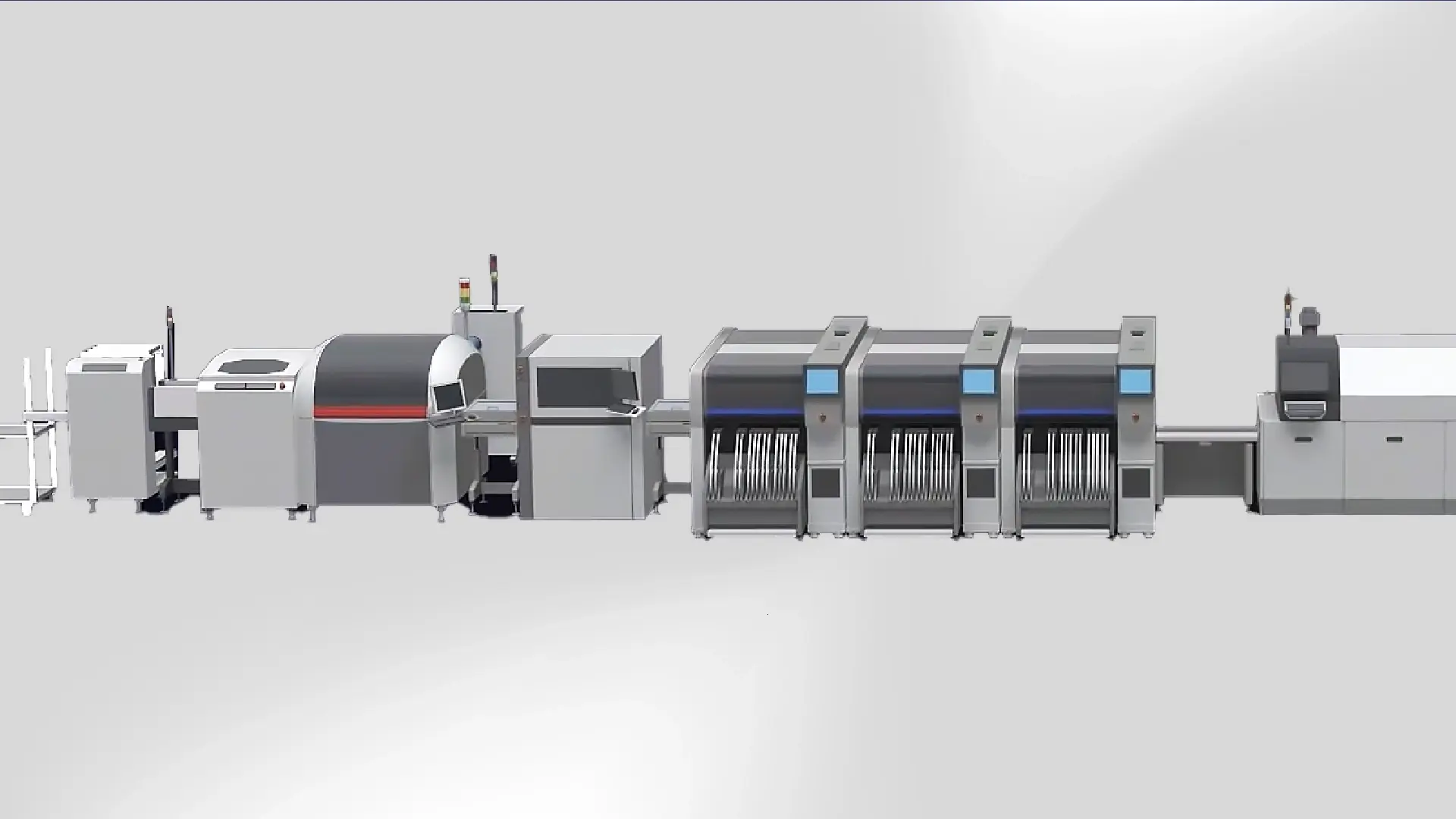
A process condition detected at one SMT machine may affect boards that are already moving toward the next production stage. When each machine is monitored separately, operators may need to coordinate containment and corrective action manually.
This Work Smarter video shows how LineWorks MES, a modular MES solution from camLine, uses machine-to-machine communication to connect process events across the SMT line. It detects reported violations, coordinates the configured response, informs responsible users, and retains the event history for later review.
Why SMT Quality Events Must Be Managed Across the Line
SMT production includes several dependent stages. A placement or inspection issue is therefore not limited to the machine where it was detected.
If information about the condition is not communicated across the line, affected production may continue to downstream equipment before the responsible team can respond.
Connected process monitoring makes the event available together with the relevant production context. This allows the response to consider the affected job, board, or process flow rather than treating the condition as an isolated machine alarm.
How LineWorks MES Supports Connected Process Monitoring
LineWorks MES connects supported machine and inspection information through line-level monitoring and control workflows.
Table 1. From Process-Violation Detection to Corrective Action
| Response stage |
How LineWorks MES supports the workflow |
| Receive the process event |
Uses machine-to-machine (M2M) communication to receive supported equipment or inspection information. |
| Detect the reported violation |
Identifies when the received event meets a configured process-violation condition. |
| Coordinate the response |
Stops or holds the affected process where the configured and supported automation design permits. |
| Inform responsible users |
Provides the information needed for engineers or operators to review the condition and take corrective action. |
| Retain the event history |
Records violation and production information for later investigation and reporting. |
LineWorks MES coordinates the digital response. It does not independently correct the physical process or confirm the root cause without engineering review.
Contain the Process Condition Before It Continues Downstream
Connected monitoring allows an SMT line to respond to a reported process violation before additional production continues through affected stages.
LineWorks MES provides the communication, production context, configured response, and historical information required to support containment and corrective action across connected equipment.
The actual control scope depends on the supported equipment interfaces and the response configured for the production environment.
Explore LineWorks Suite
FAQ
Q: Why monitor the SMT line as one connected process rather than as separate machines?
A: Monitoring the SMT line as one connected process helps teams understand how a condition detected at one station may affect products and operations elsewhere on the line. When process results are connected with the relevant production and equipment context, teams can identify what may be affected and, where control rules are configured, initiate a response before additional products are processed.
Q: How can machine-to-machine communication support an SMT quality response?
A: Machine-to-machine communication allows a process or inspection result from one station to trigger a configured response elsewhere on the SMT line. Depending on the equipment interfaces and control design, the response may include notifying responsible personnel, escalating the violation, or stopping the affected process.
Manufacturers must define which events trigger a response, which system has control authority, and how acknowledgement, overrides, and restart are managed.
Q: How does connected SMT line monitoring support root cause investigation?
A: Connected SMT line monitoring supports root cause investigation by retaining process results, violations, and associated response events. When these records are linked with the relevant unit, operation, equipment, and production context, engineers can reconstruct what happened and narrow the investigation.
The recorded history provides supporting evidence, but process knowledge and additional analysis are still required to confirm the root cause.
Q: What should be tested before enabling automated SMT line control actions?
A: Before enabling automated line control, manufacturers should validate that the correct event triggers the intended action on the correct equipment. Testing should cover:
- normal production;
- representative process violations;
- missing, duplicate, or delayed messages;
- product changes;
- station bypasses;
- rework;
- manual operations;
- equipment communication loss;
- line stops; and
- controlled restarts.
The manufacturer should also document control authority, operator overrides, response ownership, retained evidence, fallback behavior, and the boundary between MES control and machine safety systems.