
The Implementation of Single Source Recipe Management System in Semiconductor Manufacturing
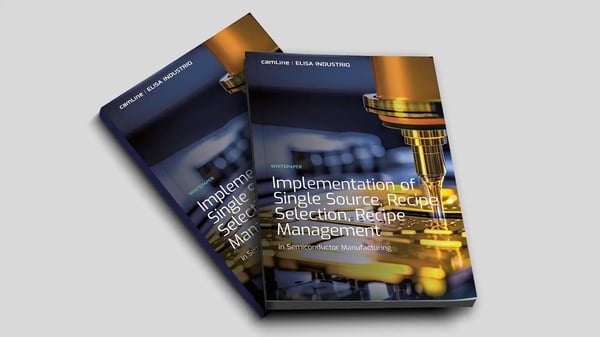
This white paper explains how a semiconductor manufacturer established centralized control over recipe selection while retaining distinct roles for its MES, recipe management system, and equipment interface.
A Practical Semiconductor Manufacturing Implementation
Managing recipe selection becomes difficult when baseline production, experiments, rework and lot-specific exceptions depend on different systems or offline processes.
This white paper documents how onsemi implemented a recipe management system alongside its MES and equipment interface. The approach uses manufacturing context to select the appropriate approved recipe while preserving traceability across production scenarios.
The paper covers the implementation architecture, recipe definition model and phased migration—not just the intended benefits.
What You Will Learn
- Why the existing MES could not fully support multivariable recipe selection in photolithography
- How the MES, recipe management system and equipment interface divide responsibilities.
- How context keys are used to identify the appropriate recipe
- How experiments, rework and lot-specific exceptions can be modeled online
- How recipe templates, validation, revisioning and approval support control
- Why the implementation was introduced through a phased migration
About the Author
-
 Tom Yokom
Director of Business Development, camLine USA
Tom Yokom has 30 years of experience in semiconductor manufacturing. His work focuses on manufacturing technologies that support reliable 24/7 production, including MES, recipe management, and SPC systems. He advocates for practical, floor-proven software that helps manufacturers improve reliability, automation, and operational control.