
Learn how LineWorks RM generates, versions, and traces DoE recipe variants from active golden or Process-of-Record recipes.
Listen to this article
Key Takeaways
- Generate experimental recipe variants from active golden or POR recipes.
- Apply predefined DoE matrices and user-selected parameters during recipe generation.
- Manage DoE templates, recipes, and version histories in one environment.
- Give engineering teams shared access to previous experimental work and retain recipe knowledge for production preparation.
Why DoE Recipe Creation Needs Structured Control
Process and recipe engineers use Design of Experiments to evaluate different combinations of process parameters. Each combination may require a recipe variant containing precisely defined parameter values.
When these variants are created manually, engineers must locate the correct reference recipe, enter the required values, identify each variant, and maintain its history. This work becomes more difficult to coordinate as the number of experimental recipes grows.
LineWorks RM, camLine’s Recipe Management System, provides a controlled environment for generating and managing these recipe variants. It gives engineering teams a consistent reference while retaining the recipe information created during experimentation.
Practical Challenges in DoE Recipe Creation
Before recipe generation is automated, engineering teams may encounter the following challenges:
| Practical challenge | What happens | Why it matters |
| Manual recipe creation | Engineers create individual variants for the parameter combinations required by the experiment. | Repetitive preparation takes engineering time and can produce inconsistencies. |
| Access to reference recipes | When reference data is not available centrally, engineers may need to retrieve and review recipes from individual tools. | Identifying the correct active recipe can require additional engineering and equipment access. |
| Limited experiment history | Previous experimental recipes, including unsuccessful or superseded variants, may not be retained in one place. | Engineers may repeat earlier work or overlook previously identified failure factors. |
How Does LineWorks RM Support the DoE Workflow?
LineWorks RM supports the DoE workflow through four connected steps. The process begins with a controlled reference recipe, applies the required factors and parameter values, manages the resulting recipes and versions, and retains the knowledge for shared engineering use and future process development.
1. Start with an Active Golden or POR Recipe
An active golden or Process-of-Record (POR) recipe provides the controlled reference for the experimental variants. Using an identified reference helps preserve the relationship between the original recipe and the variants created for the experiment. It also gives engineering teams a consistent starting point instead of relying on disconnected recipe copies.
2. Apply DoE Factors and Parameter Values
Engineers define or select the process variables required by the experimental design. The DoE matrix determines the parameter combinations used to generate the recipe variants. Each resulting recipe represents an intended experimental condition. This reduces repeated manual entry and supports greater consistency across the variants included in the experiment.
3. Manage DoE Templates, Recipes, and Versions
LineWorks RM supports the management and versioning of DoE design templates and experimental recipes. Changes can be tracked as the experimental design develops. Existing DoE designs can also be reused when appropriate. This allows engineers to build on previous work instead of recreating the complete experimental setup.
Maintaining the templates, recipes, and versions together provides a clearer record of how the experiment was designed and which recipe variants were generated.
Learn how to select the right approved recipe for production in the on-demand webinar: Getting the Right Recipes Running in Your Factories.
4. Retain and Share Recipe Knowledge
Centralized access gives research, process, and recipe engineering teams a common source for recipe definitions and experimental histories.
Teams can review previous recipes before creating new variants, reducing redundant work and supporting collaboration between the people involved in experimentation and process optimization. The retained recipe information remains available as selected processes move from R&D toward production preparation.
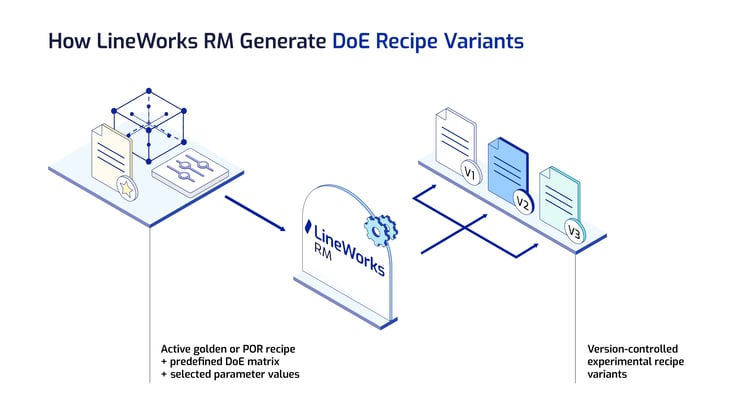 LineWorks RM combines an active golden or POR recipe with predefined DoE matrices and selected parameter values to generate traceable experimental recipe variants.
Related Industry Example: Single-Source Recipe Management
A published onsemi example describes how moving from multiple recipe-selection methods toward a single-source approach created a more consistent framework for baseline production, experiments, and lot-specific exceptions.
The manufacturer previously used several recipe-selection methods supported by different MES components. Bringing recipe definitions and selection into one framework provided more centralized control and improved recipe-related data collection. The example demonstrates the wider value of managing production and experimental recipe requirements through a consistent Recipe Management approach.
Explore the implementation in the white paper, Implementing Single-Source Recipe Management in Semiconductor Manufacturing.
Centralize DoE Recipe Generation with LineWorks RM
LineWorks RM centralizes DoE recipe generation by combining active golden or POR recipes with predefined DoE matrices, version control, and traceability. This helps engineering teams reduce repetitive work and preserve recipe knowledge from experimentation through production preparation.
Explore LineWorks RM features and capabilities.
About the Author
Danny Yeoh is VP Business Development & Customer Success at camLine. With more than 15 years of experience in manufacturing IT solutions for the semiconductor industry, he works with manufacturers on digital transformation and automation initiatives.
FAQ
Q: What is DoE-driven recipe automation?
A: DoE-driven recipe automation is a structured method for generating the recipe variants required for a Design of Experiments workflow. It uses an active golden or Process-of-Record recipe together with predefined DoE matrices and selected parameter values, reducing the need to create each experimental variant manually.
Q: How does LineWorks RM support traceability for experimental recipes?
A: LineWorks RM centrally manages DoE templates, generated recipe variants, and their version histories. This preserves the relationship between each experimental variant and its reference recipe while keeping previous recipe information available for review.
Q: How does LineWorks RM support recipe development from R&D to production?
A: LineWorks RM retains experimental recipe definitions and version histories as selected processes progress from R&D toward production preparation. This gives engineering teams access to knowledge developed during experimentation when refining recipes for later production use.